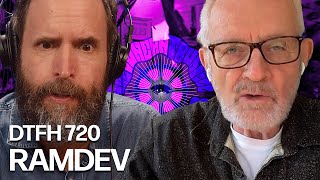
About this episodeDavid Nickturn and Duncan Trussell explore Buddhism as a practical principle of daily functionality rather tha…AI summary
David Nickturn and Duncan Trussell explore Buddhism as a practical principle of daily functionality rather than a rigid dogma or hero worship. They discuss the inseparability of absolute and relative truths, emphasizing that enlightenment does not remove worldly responsibilities but enhances one's ability to navigate them with equanimity. The conversation highlights the importance of recognizing emotional reactivity (shenpa), cultivating fundamental goodness through compassion, and applying these insights to everyday life.
Key takeaways 8
Buddhism is defined as a principle of awakening and a way of being, not a name or a single historical figure; there have been many Buddhas throughout history.
Enlightenment does not exempt one from worldly duties like paying bills or buying cat litter; rather, it brings clarity to these relative realities.
The 'two truths' (absolute and relative) are inseparable; spiritual practice involves integrating high-level awareness with mundane daily functioning without idealizing or dehumanizing practitioners.
Hero worship is a natural human tendency but can be counterproductive; the goal is to assess teachings personally rather than blindly adopting regulations from the past.
Emotional reactivity, or 'shenpa,' captures intelligence and leads to suffering; meditation practice involves observing these reactions without judgment or manipulation.
The 'hell realm' represents states of mind where one feels trapped and hopeless, such as in the case of Lindsay Clancy, but the awakened response centers on forgiveness and seeking help.
Fundamental goodness is an inherent quality of being characterized by clarity (present awareness) and warmth (compassion), which can be cultivated in any situation.
Power in the 'jealous god realm' is often mistaken for nutrition, but it does not fulfill the appetite; true fulfillment comes from compassion and connection.
Notable quotes 5AI-generated: wording and quote attribution may be wrong. Use the play link to verify.
“You don't want to be that kind of practitioner... Get that flaming sword out and see if it's true. See if it's conditionally true, absolutely true. if it's relevant, if it's expressible in contemporary uh cultural context, if it's serving the well-being of oneself and others.”
▶ 5:29David Nickturn advises listeners to critically assess Buddhist teachings rather than blindly following them, using personal experience and contemporary relevance as criteria.
“Don't panic when things are going bad... Don't relax when things are going well.”
▶ 18:45A pith instruction from David's teacher that promotes equanimity, preventing practitioners from becoming manic-depressive by chasing highs or avoiding lows.
“It's the same ingredients just sort of mixed in differently.”
▶ 24:40Duncan Trussell's analogy using Taco Bell to explain that high and low moments in life are composed of the same fundamental experiences, just perceived differently.
“If you can get you freaking out, I've already controlled you. It's like I found a trigger in you that I could switch and make you have a kind of transient seizure.”
Duncan discusses how external triggers and media can manipulate emotional reactivity, highlighting the importance of maintaining inner stability.
“That's what Buddhism is... manifesting that warmth and finding that warmth to be inherent.”
David describes the core of Buddhist practice as cultivating the warmth and compassion inherent in all beings, referencing a personal experience with a nurse during an MRI.
Chapters & Sections (32)▼
0:00Buddhism's Oral History and Assessmentchapter2
2:46Historic Buddha's Personality and Oral Tradition
4:32Assessing Buddhist Teachings and Terminology
7:38Buddhism as Principle and Daily Functionalitychapter1
9:44Enlightenment and Daily Responsibilities
12:40Hero Worship, AI, and Mentorshipchapter1
16:15Blue Chew Sponsorship and Product Review
18:31Equanimity and Inseparability of Two Truthschapter1
21:07High and Low Moments Inseparability
24:20Meditation on Emotional Reactivity and Shenpachapter1
26:51Recognizing and Dismantling Habitual Shenpa
29:16Dismantling Road Rage and Aggression Through Meditationchapter1
32:30Chess Metaphor and Reducing Aggression
34:39Power as Nutrition in Six Realmschapter1
37:06Power as Nutrition in Six Realms
39:27Forgiveness in Hell Realmchapter2
41:30Self-Forgiveness and Intermediary Help
43:29Shopping for Fall Clothes
44:50Compassion and Asking for Help in Dharmachapter1
47:12Asking for Help and Compassion
50:09Buddhism: Warmth, Clarity, and Basic Goodnesschapter2
51:48Buddha Nature: Warmth and Clarity
53:48Basic Goodness vs. Punitive Religion
56:06Cultivating Compassion and Extracting Goodnesschapter1
58:20Cultivating Compassion Through Bodhicitta Practice
1:03:10Integrating Creativity and Mindfulness Practicechapter2
1:06:02Learning Fundamentals Before Improvisation
1:07:50Personalized Spiritual Access and Heart Connection
1:09:45Creativity and Capturing Funny Momentschapter3
1:12:13Noticing Funny Moments Not Creating Them
1:13:36Mindfulness Teacher Training Program Details
 1h 25m⏭ 4
 2h 52m⏭ 4
 1h 48m⏭ 4
 1h 52m⏭ 2
 1h 44m⏭ 3
 1h 6m⏭ 3
 2h 22m⏭ 6
 2h 31m⏭ 2
 1h 25m⏭ 4
 1h 44m⏭ 3
 1h 36m⏭ 4
 2h 16m
 1h 50m⏭ 3
 1h 11m⏭ 3
 27m
27m 4h 14m⏭ 3
 1h 3m⏭ 2
 2h 16m
 2h 6m⏭ 1
 1h 24m⏭ 2
 1h 25m
 2h 28m
 4h 26m⏭ 3
 1h 38m⏭ 1
 11h 23m⏭ 1
 33m
33m 3h 54m⏭ 7
 46m
46m 1h 0m⏭ 1
 48m⏭ 2
 1h 16m
 3h 59m⏭ 5
 1h 13m
 25m
25m 25m
25m 45m⏭ 2