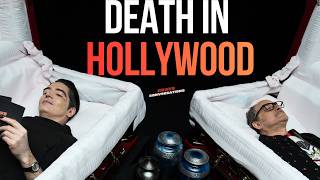
About this episodeHorror filmmaker Leigh Whannell discusses his deep-seated fear of death, which drives his creative work, while…AI summary
Horror filmmaker Leigh Whannell discusses his deep-seated fear of death, which drives his creative work, while sharing personal anecdotes about Australian culture and his journey with the Saw franchise. He offers profound insights on the non-linear nature of grief following the suicide of his brother-in-law and emphasizes the importance of honest, present-focused living. The conversation blends humor about funeral plans with serious reflections on mental health and parenting children with learning differences.
Key takeaways 5
Grief is not linear and does not follow the 'seven stages' model often portrayed in media; it fluctuates moment-to-moment, shifting from sobbing to laughing unexpectedly.
The creation of the first Saw film was not a calculated blockbuster strategy but a low-budget effort by two guys hoping to make a straight-to-video movie, making its success a 'bonus prize.'
Depression and suicide are diseases that distort reality, leading sufferers to believe they are a burden; this is a lie that loved ones must help counter by reaching out.
Authentic creative passion is identifiable internally: if a writer isn't excited enough to be kept awake at night by a project, they likely aren't the right person to write it.
Australian identity provides a unique cultural perspective, with Whannell noting that Australia is often viewed as a universally liked, non-divisive country compared to others.
Notable quotes 4AI-generated: wording and quote attribution may be wrong. Use the play link to verify.
“Grief isn't linear. It doesn't look like it does in the movies... It's a thing that follows you around and it's there even when you're in a great mood, you know, it's still hovering behind you.”
▶ 19:33Whannell reflecting on the reality of grief after the suicide of his brother-in-law, contrasting it with media portrayals.
“It's like for some people life just gets too painful and it seems easier to go away than to hang around. People who are in a really really dark hole think that they are a burden to those around them... It's never true.”
▶ 23:23Explaining the mindset behind suicide and urging those suffering to reach out, as their perceived burden on others is a delusion of the disease.
“A screenplay is a promise. It's a promise for something that might happen in a year. You're spending a lot of your life in the future.”
▶ 18:32Discussing how screenwriters live in the future, and how knowing one had only one year left to live might shift him to be more present-focused.
“Is it possible to be humble and brilliant? Is it possible to be gorgeous and a man of the people? Is it possible to be insanely creative but also a real collaborator with people? Yes, it is. The answer lies in this casket in front of us today.”
▶ 28:53Whannell's self-delivered eulogy, using humor to affirm his own qualities while acknowledging the absurdity of the situation.
Chapters & Sections (13)▼
0:05Horror Filmmaker's Fear of Death and Australian Identitychapter2
2:08Host's Introduction and Fan Anecdote
3:14Australian Identity and Wolf Creek Praise
5:22Australian Spiders and Movie Memorieschapter
10:03Saw Production and Invisible Man Filmingchapter1
12:56Invisible Man Emotional Scene Filming
15:22End of Life Preferences and Grief Realitieschapter3
18:10Present Focus and Grief Realities
20:36Emotional Volatility and Personal Loss
21:52Depression as Disease and Grief in Filmmaking
24:07Funeral Plans, Parenting, and Writing Processchapter2
 23m
23m 24m
24m 20m
20m 22m
22m 28m
28m 27m
27m 1h 21m⏭ 4
 1h 6m⏭ 1
 1h 21m⏭ 4
 29m
29m 1h 57m
 1h 6m⏭ 1
 2h 15m⏭ 2
 49m
49m 1h 15m
 1h 34m⏭ 3
 2h 26m⏭ 3
 1h 15m⏭ 2
 11h 23m⏭ 1
 33m
33m 1h 0m⏭ 1
 46m
46m 3h 54m⏭ 7
 48m⏭ 2
 3h 59m⏭ 5
 1h 16m
 1h 13m
 54m⏭ 1
 25m
25m 38m
38m