Results for “compute”


How Close Are We to True Artificial General Intelligence? | OpenAI’s Greg Brockman Speaks to TIME
OpenAI is transitioning from a chatbot model to an enterprise-focused strategy, aiming to transform the economy into a 'compute-powered' one where AI agents handle up to 80% of software engineering work.takeaway“We are transforming the economy to be a compute powered one. And I think that what an enterprise even is will change.”quote

Anthropic's $30T Assumption & OpenAI Confirms IPO | Why Customer Service & Robotics are Overinflated
Finally, the conversation explores the emerging challenge for enterprises to manage 'token addiction' and allocate AI compute costs effectively as a finite financial resource.summaryEnterprises are entering a phase of 'token addiction' where AI usage is becoming essential for productivity, forcing CFOs to treat compute costs like capital—requiring strict allocation and budgeting rather than unlimitetakeaway

What’s happening with US data centers? | The Vergecast
Generative AI is accelerating the need for compute capacity, forcing data centers to use noisier natural gas turbines and diesel generators when grid connections are delayed, exacerbating environmental and quality-of-liftakeaway“"The cloud basically is data centers... AI also needs data centers and because they require so much compute they need more and more capacity than cloud did in the past."”quote
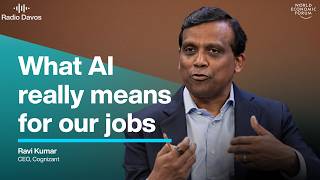
AI's real impact on jobs - what it means for you, your company and future generations
Reskilling must be integrated into the 'infrastructure stack' alongside compute and LLM access, not treated as a peripheral activity.takeaway“Reskilling should be a part of the infrastructure stack. It cannot be done on the side. You have to look at it with the same lens as you look at it for compute, for LLM access.”quote

Sam Altman And Howard Lutnick Discuss AI, Economy At G20 Innovation Ministerial
Altman emphasizes the need for pragmatic risk management and abundance of compute to ensure AI democratizes education and opportunity rather than concentrating power.summaryCompute scaling and democratization: Usage is projected to grow exponentially, with the average person's token usage rising from 100,000/month in 2020 to 100 billion/month in the future; this requires massive infrastructtakeaway




Jensen Huang: NVIDIA - The $4 Trillion Company & the AI Revolution | Lex Fridman Podcast #494
AI as a Factory, Not a Warehouse: Computing has shifted from storage/retrieval (warehouses) to generation (factories). This changes the economic model where 'tokens' become a revenue-generating commodity with varying valtakeawayAgentic Scaling Law: Beyond pre-training and inference scaling, the next phase is 'agentic scaling' where AI agents spawn sub-agents to perform tasks. This multiplies compute requirements and creates a feedback loop whertakeawayHuman-AI Collaboration Model: AI automates tasks but does not replace the purpose of jobs. Using the radiologist example, superhuman computer vision increased the demand for radiologists because it allowed them to diagnotakeaway

Jensen Huang: Nvidia's Future, Physical AI, Rise of the Agent, Inference Explosion, AI PR Crisis
He argues that AI compute consumption will grow exponentially (1 millionx), creating massive economic opportunities in physical AI, robotics, and digital biology, while advising entrepreneurs to focus on deep vertical spsummary“We understand a lot of things about this technology... It is not a biological being. It is not alien. It is not conscious. It is computer software.”quote

AI Will Change Humanity Faster Than You Think | Bohan Lou
He analyzes the competitive landscape between US and China, noting China's dominance in open-source AI models and rapid infrastructure build-out, while the US retains advantages in talent, capital markets, and compute resummaryUS Structural Advantages: Despite China's progress, the US maintains three key advantages: a continuous 'brain drain' of global talent, deeper and more risk-tolerant capital markets, and superior access to compute resourtakeaway


2026 Predictions: AI Automates Knowledge Work, Autonomous Robots & AI CEO Billionaires | EP #217
Level 5 Automation: Immod predicts Level 5 autonomy for cars and robots will be achieved technically in 2026 via massive cloud compute clusters, though regulatory hurdles and supply chain limits may delay mass adoption.takeaway“You can now scale health through compute... if you put enough money behind these trials... where is the limit?”quote

Why World Models Could Change Robotics, 3D, and Creativity
Future development focuses on scaling compute, enhancing dynamics, and improving editability to bridge the gap between simulation and real-world robotic deployment.summaryScaling laws apply to spatial intelligence; performance improves predictably with model size and training duration, suggesting the current bottleneck is compute rather than architectural breakthroughs.takeaway