Results for “Descartes”
Transcript mentions 28
See all ›
Should We All Be Nihilists? (Feat. Rationality Rules and Rachel Oates)
3:38in the sense that i think descartes was right when he said that i think therefore i am and that's the8:18at the heart of it is what i was just saying about descartes which is you can't really verify anything to 1008:57some pretty hefty assumptions but ultimately can be based in the the objective claim of descartes
“You’re Extremely British” | Meeting Peter Boghossian
42:34here's a chief belief that I this is kind of a from a play on on Descartes59:35Descartes entire point is to say well I can imagine that is the table actually there well no1:00:14it's yeah teaching I mean so Descartes was criticized because it's a kind of solipsism or uh some people living oddly
Topics & chapters 10
See all ›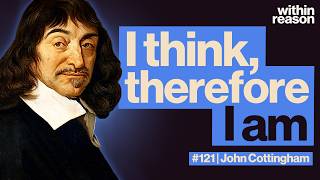


AI summaries 6
See all ›Descartes Explained: I Think, Therefore I Am
This conversation provides a comprehensive analysis of René Descartes' philosophy, focusing on his method of doubt, the Cogito, and his arguments for God's existence.summaryDescartes' Method of Doubt involves three waves: sensory unreliability (e.g., stick in water), the dreaming argument (uncertainty of external reality), and the malicious demon hypothesis (systematic deception).takeawayDescartes is a Rationalist, believing knowledge comes from innate ideas within the mind rather than external observation (Empiricism).takeaway
"I Think Therefore I Am" Explained
The video analyzes René Descartes' 'Cogito, ergo sum' (I think, therefore I am), arguing that the traditional translation is misleading and that the phrase represents an immediate intuition rather than a logical syllogissummaryThe content also explores Descartes' method of radical doubt, including the Evil Demon thought experiment, to establish a foundation for philosophical knowledge.summaryRationalism vs. Empiricism: Descartes was a rationalist who believed in a priori knowledge (independent of experience), contrasting with empiricists like David Hume who believed all knowledge comes from a posteriori senstakeaway
10 Philosophy Books BANNED By The Catholic Church
It details specific philosophical and scientific works that were banned, including Descartes' Meditations, Pascal's Pensées, Galileo's Dialogue, Hume's Dialogues, Hobbes' Leviathan, Rousseau's Social Contract, and Kant'ssummaryBlaise Pascal criticized René Descartes for using God merely as a foundational tool to justify epistemology ('one flip to set the world in motion') before having no further use for Him.takeaway“I cannot forgive Descartes. He would gladly have left God out of his whole philosophy, but he could not help making him give one flip to set the world in motion. After that, he had no more use for God.”quote
Who Is The Best Philosopher? 16 Thinkers, Ranked - Episode 100
Through head-to-head debates, they evaluate figures like Descartes, Hume, Nietzsche, and Aristotle based on historical influence, logical rigor, and practical application, ultimately crowning Aristotle as the winner.summaryDescartes' 'Cogito, ergo sum' is best understood not as a formal syllogism but as a baseline intuition that doubt requires a doubter, making it a precondition for thought rather than absolute proof of existence.takeaway