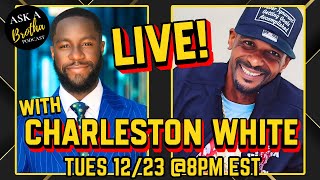
About this episodeCharleston White details his journey from a middle-class suburban childhood marked by severe physical trauma a…AI summary
Charleston White details his journey from a middle-class suburban childhood marked by severe physical trauma and gang mimicry to serving seven years in juvenile detention for a murder case. He explains how his advocacy work and exposure to the realities of youth violence transformed him into a controversial internet figure dedicated to holding hip-hop culture and community leadership accountable. The conversation highlights his strategic use of comedy and shock value to separate his online persona from his serious community activism.
Key takeaways 5
Childhood trauma and lack of positive male role models drove White to mimic gang culture for affirmation, despite not being poor or from the hood.
White distinguishes between the 'character' of a rapper and the real person, citing Nipsey Hussle's funeral as a pivotal moment where he realized the humanity behind the public image.
His online persona is a deliberate 'character' created to protect his real-life community work from being overshadowed by clickbait, allowing him to use shaming tactics to mobilize local support.
The juvenile justice system in Texas at the time allowed for sentences up to 40 years for minors, and White was sentenced to 12 years (serving 7) under this law.
White identifies America, Sudan, and North Korea as the only countries that sentence children to life without parole, driving his advocacy with organizations like ICAN.
Notable quotes 5AI-generated: wording and quote attribution may be wrong. Use the play link to verify.
“I never was a killer. I never was a gangster. I was a kid that wanted to be a part of something and I almost threw my life away by trying to be a part of something that I didn't come from.”
▶ 19:02Explaining his motivation for joining gangs as a teenager seeking identity and affirmation.
“Confucious said, 'He who controls images controls minds,' and I realize that these images controls our minds.”
▶ 26:38Justifying his critique of hip-hop culture and media influence on youth.
“I am a snitch beside of the police. I'm the neighborhood community watch... If I find out Ray Ray them shot up that house, I'm going find I'm going to tell on Ray Ray now and I'm going to let everybody know.”
▶ 34:06Defending his willingness to report crimes and hold community members accountable.
“I separated the two... when Lauren London's son got up and spoke... 'Last night came to me in a dream and he was in heaven.'... That funeral changed the spirit of a man and I was that man.”
▶ 27:35Describing the moment he stopped seeing rappers solely as 'studio gangsters' and recognized their humanity.
“I didn't want the internet to supersede my real life actions. So, I had to think of a way to separate Charleston from the internet. And that's when I discovered, 'Okay, [__] you funny.'”
▶ 30:22Explaining the strategic creation of his comedic online persona.
Chapters & Sections (26)▼
0:08Celebrity Car Culture and Personal Brandingchapter3
0:08Former Gang Member Turned Social Media Influencer
2:08Growing Up in a Traditional African-American Home
3:56Growing Up in a Troubled Family Environment
7:14Childhood Accidents and Injurieschapter3
7:14Childhood Injuries and Traumatic Experiences
9:09Childhood Trauma and Medical Complications
10:42Childhood Trauma and Physical Disability
12:25Adolescent Exposure to Gang Culturechapter2
12:25Adolescent Struggle with Gang Culture Influence
14:49Adolescent Rebellion and Juvenile Delinquency
18:07Childhood Trauma and Gang Involvementchapter2
18:07Rehabilitation and Redemption from Gang Life
21:07Overcoming Childhood Trauma and Juvenile System Issues
23:49Youth Advocacy and Social Justice Activismchapter2
23:49Youth Advocacy and Social Justice Activism
25:57Separating Reality from Public Image
29:18Balancing Authenticity and Online Personachapter8
29:18Balancing Authenticity and Online Persona
31:23The Reality of Jail and Hip-Hop Accountability
33:03Community Activism and Personal Growth Strategies
35:02Maintaining Purpose Amidst Fame and Success
37:01Debunking Online Misconceptions and Personal Growth
38:56Confrontation with Soulja Boy and His Entourage
40:42Tupac's Influence on Personal Spirituality and Growth
42:32Redemption and Personal Growth Through Adversity



 1h 41m
 1h 51m⏭ 2
 32m⏭ 1
 1h 53m⏭ 1
 2h 16m
 28m
28m 1h 52m
 27m⏭ 2
 4h 5m⏭ 4
 2h 20m
 2h 10m
 1h 10m
 2h 30m⏭ 3
 2h 3m⏭ 1
 2h 8m
2h 8m 1h 8m
1h 8m 2h 21m⏭ 2
 1h 50m⏭ 1
 3h 48m⏭ 3
 6h 27m⏭ 3
 1h 43m⏭ 4
 11h 54m
 11h 54m⏭ 8
 1h 0m⏭ 1
 33m
33m 6h 26m
 9h 11m
 3h 54m⏭ 7
 3h 59m⏭ 5
 46m
46m 1h 16m⏭ 2
 54m⏭ 1