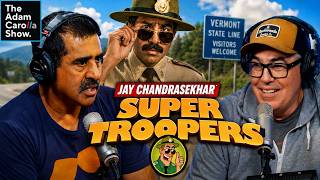
About this episodeJay Chandrasekhar details his journey from being an Indian-American outsider in the Midwest to becoming a pion…AI summary
Jay Chandrasekhar details his journey from being an Indian-American outsider in the Midwest to becoming a pioneering Indian comedian and director in Hollywood. He explains how he bypassed traditional casting barriers by writing, directing, and starring in his own films, specifically highlighting the success of Super Troopers and The Dukes of Hazzard reboot. The conversation also covers his experiences with cultural stereotypes, arranged marriage traditions, and the importance of persistence and craftiness in navigating the entertainment industry.
Key takeaways 5
Overcoming Industry Barriers: Chandrasekhar realized that as an Indian actor, he was limited to stereotypical roles (like Long Duck Dong). To break through, he learned to write, direct, and produce his own films, forcing Hollywood to cast him in non-stereotypical roles by creating the content himself.
The Power of Independence: He leveraged the 1990s independent film boom (exemplified by Miramax buying Super Troopers) to launch his career, noting that this window of opportunity for low-budget, wide-release comedies has largely closed in the streaming era.
Cultural Shifts in Representation: He observes that representation improves when diverse writers enter the room (e.g., a Black writer creating a nuanced Black character) rather than relying on majority-white writers attempting to write diverse stories, which often results in caricatures.
Navigating Social Dynamics: Growing up as one of the few Indian families in a white suburb, he faced subtle racism and exclusion in dating but used humor and athletic ability (being fast) to integrate socially, distinguishing between malicious racism and mere social preference.
Family Dynamics and Tradition: His parents' relationship defied traditional arranged marriage norms; his father chose his mother despite caste differences and family opposition, highlighting a generational shift in Indian-American families regarding autonomy in partner selection.
Notable quotes 5AI-generated: wording and quote attribution may be wrong. Use the play link to verify.
“Show business is like a tiny island of success in a vast ocean of rejection.”
▶ 48:51Chandrasekhar describing the resilience required to maintain a career in Hollywood.
“I don't see it as racist. I just see it as a natural way that people write. When I write, I write an Indian in almost everything I do because I'm writing for me.”
▶ 52:05Explaining why he creates his own roles instead of waiting for inclusive casting opportunities.
“The country is very big-hearted that it was like, sure, great, fine, that's funny, funny is funny... if it's just funny, then I think people resonate and relate to that.”
▶ 47:47His perspective on how comedy transcends racial barriers when the material is genuinely humorous.
“I'm the Jackie Robinson of Indian comedians.”
▶ 33:36Chandrasekhar describing his role as a pioneer for Indian actors in mainstream American comedy.
“You have to be crafty about it... if they make the wrong decisions enough they get fired. And if they make a right decision and they make some money they're like hey look who's the genius.”
▶ 50:40Advice on how to pitch projects to executives by timing your approach strategically.
Chapters & Sections (48)▼
0:05Upcoming Tour Dates and Promotional Announcementschapter3
0:05Upcoming Tour Dates and Show Promotions
2:04Promoting Personal Projects and Recommendations App
3:27Criticisms of Movie Recommendation Apps
4:54Childhood and Family Origins in Indiachapter2
4:54Arranged Marriages and Cultural Family Traditions
6:58Arranged Marriages and Family Dynamics
9:25Arranged Marriages and Cultural Expectationschapter2
9:25Arranged Marriages and Cultural Expectations
11:11Family History and Social Expectations
13:54Women's Rights and Empowerment in Indiachapter3
13:54Women in Medicine and Leadership
15:38Growing Up as an Indian in a Predominantly White Area
16:51Racial Stereotypes and Childhood Experiences
18:49Growing Up with Racially Charged Humorchapter2
18:49Growing Up with Racially Charged Humor
21:24Racial Equality and Social Prejudices in America
23:06Making Comedy Career Choices and Family Expectationschapter3
23:06Making Comedy Career Choices and Family Expectations
24:46Childhood Experiences in Boarding School
25:59Boarding School Life and Peer Pressure Experiences
29:30Early Career in Theater and Improvchapter2
29:30Early Career in Theater and Improv
31:12Breaking into the Entertainment Industry
33:36Breaking into Hollywood as a Minority Comedianchapter3
33:36Breaking into Hollywood as Independent Filmmakers
35:23Overcoming Racial Barriers in Show Business
36:43Challenges of Unconventional Career Paths
38:12Parental Influence on Teenage Substance Abusechapter2
38:12Parental Influence on Teenage Substance Abuse
40:46Early Success and Representation in Media
43:08The Changing Landscape of Independent Film Distributionchapter2
43:08Changes in Independent Film Distribution Models
44:52Breaking Stereotypes in Media Representation
47:26The Power of Authentic Comedy and Resiliencechapter4
47:26The Power of Comedy to Overcome Obstacles
49:04Persistence in the Face of Rejection
50:28Breaking Stereotypes in Film Industry
51:48Diversity in Writing Rooms and Representation
53:33Stunts and Risks on Movie Setschapter3
53:33Stunts and Behind-the-Scenes of Dukes of Hazzard
55:45Stunts and Vehicle Logistics in Film Production
56:58Directing a Movie with a Sensitive Prop
59:22Retro TV Show Dukes of Hazzard Discussionchapter4
59:22Racial Sensitivity in Classic TV Show Adaptations
1:00:45Directing Entourage and Hollywood Experiences
1:02:16Pitching Ideas to Industry Professionals
1:03:49The Importance of Being Open-Minded in Creative Projects
 1h 40m⏭ 3
 1h 3m⏭ 2
 37m⏭ 1
 1h 4m⏭ 3
 1h 5m⏭ 2
 35m⏭ 2
 58m⏭ 2
 ⏭ 2
⏭ 2 1h 0m⏭ 1
 34m⏭ 2
 1h 8m⏭ 2
 1h 10m⏭ 1
 1h 20m
 2h 54m⏭ 3
 2h 12m
 1h 53m
 1h 49m⏭ 2
 1h 2m⏭ 3
 2h 20m
 57m⏭ 4
 2h 19m⏭ 4
 50m
50m 2h 0m⏭ 3
 1h 57m⏭ 1
 11h 23m⏭ 1
 33m
33m 1h 0m⏭ 1
 46m
46m 48m⏭ 2
 3h 54m⏭ 7
 3h 59m⏭ 5
 1h 13m
 38m
38m 54m⏭ 2
 10h 34m
 25m
25m