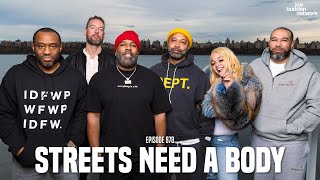
About this episodeThe discussion analyzes Conor McGregor's post-peak career motivations, attributing his continued activity to a…AI summary
The discussion analyzes Conor McGregor's post-peak career motivations, attributing his continued activity to a desire for relevance rather than financial necessity, while contrasting this with Khabib Nurmagomedov's disciplined retirement despite massive offers. It further explores the developmental advantages of Russian fighters, citing early specialization and a 'need-based' mentality driven by socioeconomic factors, and concludes that children of transcendent athletes face insurmountable pressure to replicate their parents' greatness.
Key takeaways 5
Conor McGregor's post-Floyd/McGregor-Khabib career is driven by a need for notoriety and relevance rather than financial gain, as he has already secured approximately $500 million from his liquor business and $100 million from the Floyd Mayweather fight.
Khabib Nurmagomedov's refusal to return to MMA, despite a reported $40 million offer, highlights his complete detachment from the sport's commercial incentives, likely due to his secure life in Dagestan.
Elite Russian wrestlers like Khabib and Islam Makhachev benefit from early specialization in combat sports (starting around age 5-6) and a developmental environment where fighting is viewed as a necessary means to change one's socioeconomic status.
Children of transcendent athletes (e.g., LeBron James Jr., Tom Brady's son) face unique psychological burdens; the host argues it is statistically and psychologically improbable for them to match their parents' greatness due to immense external pressure and lack of 'need' to fight for survival.
The host contrasts his own upbringing with his son's current life, noting that while his son has every resource available, he lacks the 'dog mentality' born from hardship that drove the host's success, though he values the son's willingness to work hard regardless of outcome.
Notable quotes 5AI-generated: wording and quote attribution may be wrong. Use the play link to verify.
“He wants to stay relevant, right? He wants to stay in the news. He wants the notoriety of being Conor McGregor without having to be Conor McGregor.”
▶ 0:39Guest explains McGregor's motivation for continuing to fight after achieving massive financial success.
“It's hard to get up in the morning when you're sleeping on satin sheets.”
▶ 16:02Guest cites Marvin Hagler's quote to explain why wealthy fighters like McGregor lack the drive to compete at an elite level compared to those with less security.
“God ain't going to bless you like that, bro. I'm sorry. That's not... It's hard.”
▶ 8:06Guest discusses the impossibility of expecting children of legends like Tom Brady or LeBron James to replicate their fathers' historic achievements.
“I embraced it. Every number he had, I got the exact same number... I never looked at like, and when people told me, I man, you're not going to be like your brother.”
▶ 10:00Guest shares his personal mindset regarding living in the shadow of his brother DC, highlighting a specific psychological approach to handling comparison.
“If it works, awesome. If it doesn't, you gave yourself a chance. You took advantage of every opportunity you had. Everything that we have acquired, you use to try to better yourself.”
▶ 11:07Guest explains his parenting philosophy: valuing the effort and utilization of resources over the final outcome.
Chapters & Sections (41)▼
0:00Conor McGregor's Career and Public Perceptionchapter3
0:00Conor McGregor's Rise to Wealth and Fame
0:30Conor McGregor's Impact on Modern MMA
0:55UFC Fighter Analysis and Critique
1:25Khabib's Feud with Conor McGregor Explainedchapter3
1:25Feud Between Khabib and American Fighter
1:55Physical Altercation in a Sports Setting
2:16Consequences of Underestimating an Opponent
2:43MMA Fighter Retirement and Financial Offerschapter2
2:43Khabib's Post-Retirement Career and Financial Offers
3:15MMA Fighter Salaries and Negotiations
4:03Early Development of Elite Wrestlerschapter1
4:03Early Development of Elite Wrestlers
5:32Parental Influence on Athlete Developmentchapter3
5:32Parental Expectations for Child's Athletic Commitment
6:00Developing Resilience and Mentality in Athletes
6:21Parental Legacy and Expectations
6:48Comparing Athlete Legacies and Expectationschapter2
6:48Comparing Generational Athletic Ability and Expectations
7:21Comparing Generational Athletes and Their Sons
8:04Pressure on Children of Famous Athleteschapter2
8:04Expectations for Children of Famous Athletes
8:51Pressure of Living Up to Family Expectations
9:34Overcoming the Shadow of a Family Legacychapter3
9:34Embracing a Legacy and Living Up to Expectations
10:15Overcoming Privilege and Entitlement Mentality
10:37Daily Routine and Sports Training Schedule
11:01Importance of Taking Opportunities in Lifechapter2
11:01Importance of Taking Opportunities in Life
11:49Training a Foreign Wrestler in the US
12:26The Dominance and Character of a Fighterchapter2
12:26Dominant Fighters and Their Impact on Others
13:14Respect and Chivalry in Public Behavior
13:43Respect and Cultural Differences in Handshakingchapter4
13:43Respectful Gestures in Live TV Situations
14:11Cultural Differences Between Russian and American Fighters
14:40Challenges of Growing Up in Poverty
15:07Comparing Life Standards in Different Environments
15:32The Futility of Fighting for Financial Securitychapter2
15:32Financial Motivations for Continuing Boxing Career
 2h 14m⏭ 2
 1h 36m⏭ 3
 2h 2m⏭ 3
 2h 18m⏭ 4
 3h 14m⏭ 1
 2h 14m⏭ 1
 2h 49m⏭ 5
 2h 43m⏭ 1
 1h 47m⏭ 4
 2h 49m⏭ 1
 2h 50m⏭ 3
![Deon Cole [CLEAN] Dated Shaq's Ex, Wrote For Diddy, Katt Williams & Talks Kevin Hart, Paul McCartney](https://img.youtube.com/vi/KQWyslsMc9E/mqdefault.jpg) 2h 19m⏭ 3
2h 19m⏭ 3
 2h 24m
 1h 34m⏭ 1
 49m⏭ 1
 43m
43m 55m
55m 1h 0m⏭ 2
 2h 1m⏭ 3
 1h 7m
1h 7m 2h 27m⏭ 3
 2h 10m
 3h 1m⏭ 1
 1h 35m⏭ 2
 1h 0m⏭ 1
 33m
33m 3h 59m⏭ 5
 46m
46m 3h 54m⏭ 7
 54m⏭ 1
 1h 13m
 9h 11m
 1h 26m
 54m⏭ 2
 6h 26m
 58m⏭ 5