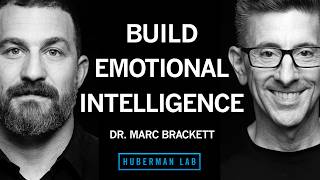
About this episodeDr. Mark Brackett shares how childhood trauma and the intervention of an 'Uncle Marvin' figure led him to co-d…AI summary
Dr. Mark Brackett shares how childhood trauma and the intervention of an 'Uncle Marvin' figure led him to co-develop the SEAL curriculum and define Emotional Intelligence (EI). He outlines the RULER framework—Recognize, Understand, Label, Understand, Regulate—as a scientific approach to managing emotions, emphasizing that EI is a learnable skill rather than a fixed trait.
Key takeaways 5
The 'Uncle Marvin' effect: Research shows only one-third of people have a non-judgmental, warm adult in their past who gave them permission to feel; this presence correlates with 15% higher purpose and meaning in life.
Emotional Intelligence Definition: EI is not about suppressing emotions but using them wisely to achieve goals. It involves four skills: Recognizing emotions in self/others, Understanding causes/consequences, Labeling with precision, and Regulating responses.
Granularity matters: Mislabeling emotions leads to ineffective strategies. For example, Yale students labeled 'stress' were actually feeling 'envy'; misidentifying anxiety as stress prevents addressing the root cause (uncertainty).
Regulation Strategies: Effective regulation includes prevention (preparing before an event), shifting (changing emotion type), maintaining (prolonging positive states), and boosting (enhancing current states).
Co-regulation vs. Coddling: Healthy co-regulation involves supporting someone through difficulty without fixing it or taking over (e.g., watching a child climb a rock while ensuring safety), which builds resilience rather than dependency.
Notable quotes 5AI-generated: wording and quote attribution may be wrong. Use the play link to verify.
“Emotional intelligence is using your emotions wisely to achieve your goals.”
▶ 25:53Defining EI in contrast to the common misconception that it means being overly emotional or losing control.
“The key is that for yourself, for your loved one, for your kids, for your colleague, really getting at that level of granularity will help you have a solution.”
▶ 47:11Explaining why precise emotional labeling (e.g., distinguishing anxiety from stress) is critical for choosing the right coping strategy.
“Observe instead of absorb.”
▶ 1:27:03Describing the 'spatial distancing' technique where one visualizes a stressful person or situation in a box/frame to create psychological distance.
“Never worry alone.”
A core principle of co-regulation, emphasizing that sharing emotional burdens with others is a strength, not a weakness.
“I'm just curious, Mark. For whom are you and Uncle Marvin?”
▶ 1:37:34An audience member's question that prompted Brackett to realize he needed to be the non-judgmental listener for others, not just receive it.
Chapters & Sections (47)▼
0:00Childhood Trauma and Family Backgroundchapter2
2:04Mother's Neuroticism and Grandfather's Liquor Store
3:24Childhood Abuse and Family Background
4:35Childhood Trauma and Uncle Marvin's Impactchapter2
7:13Uncle Marvin's Role in Disclosure
8:59Uncle Marvin's Non-Judgmental Emotional Support
13:04Childhood Trauma and Social Isolationchapter6
14:35National TV Disclosure of Abuse
16:19Bullying, Eating Disorders, and Abuse Disclosure
19:22Non-Traditional Career Path and Martial Arts
20:35Mother's Death and Career Rejection
21:57Uncle's Retirement and Book Collaboration
23:26PhD Journey and Emotional Intelligence Definition
25:07Emotional Intelligence Definition and Political Pushbackchapter1
27:37Resilience vs Fragility in Emotional Intelligence
29:46Emotional Intelligence Skills and Autismchapter1
32:06Recognizing Emotions in Autism
34:13Distinguishing Anger and Disappointmentchapter1
35:48Misinterpreting Emotions and Behavior
38:16Attribution Errors and Shared Emotional Experienceschapter2
39:44Perceived Injustice and Microaggressions
40:52Shared Emotions and Emotional Intelligence
43:07Distinguishing Anxiety, Stress, Pressure, and Fearchapter1
45:11Differentiating Anxiety, Stress, Pressure, and Fear
47:46Mislabeling Stress as Envy and Need for Lovechapter1
49:41Manufactured Identities and Intrinsic Worth
52:32Cultural Differences in Emotional Expressionchapter1
57:10Personal Strategies for Emotional Expression
58:41Emotional Regulation and Healthy Coping Strategieschapter2
1:00:37Personal Crisis and Emotional Intelligence Study
1:02:52Evaluating Emotional Impact and Autonomy
1:05:29Emotional Impermanence and Trigger Managementchapter2
1:06:49Misconceptions About Emotional Permanence
1:08:16Emotional Impermanence and Trigger Management
1:10:33Emotional Triggers and Self-Workchapter2
1:13:11Power Dynamics and Emotional Security
1:14:37Noticing Emotions Without Automatic Reaction
1:16:00Emotion Regulation Goals and Strategieschapter4
1:17:42Fixed Mindset and Emotional Regulation
1:19:18Preventing Unwanted Emotions Proactively
1:20:37Intentional Emotion Initiation and Maintenance
1:22:16Breathing and Deactivating the Nervous System
1:24:51Cognitive Strategies and Co-regulation Techniqueschapter1
1:26:49Cognitive Strategies and Co-regulation
1:29:33Healthy Co-regulation and Emotional Resiliencechapter1
1:31:50Building Emotional Muscle Through Co-regulation
1:34:28Emotional Balance and Self-Compassion Strategieschapter
 2h 31m⏭ 2
 2h 4m⏭ 2
 2h 36m
 1h 28m⏭ 3
 2h 5m⏭ 1
 2h 17m
 1h 14m
 2h 0m⏭ 2
 1h 2m⏭ 2
 2h 8m
2h 8m 2h 26m⏭ 2
 1h 50m
 2h 27m⏭ 4
 1h 27m
 2h 2m⏭ 4
 1h 13m
 6h 27m⏭ 3
 1h 24m
 2h 27m⏭ 6
 2h 6m⏭ 2
 2h 9m⏭ 2
 1h 29m
 2h 9m⏭ 8
 1h 25m⏭ 2
 1h 0m⏭ 1
 33m
33m 46m
46m 3h 54m⏭ 7
 3h 59m⏭ 5
 54m⏭ 1
 1h 13m
 54m⏭ 2
 58m⏭ 5
 1h 16m⏭ 2
 45m⏭ 2
 1h 26m