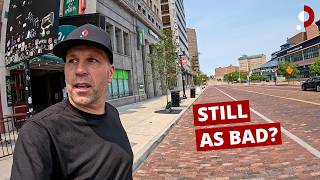
About this episodeMillinocket, Maine, was a company town built by the Great Northern Paper Company that closed in 2008, causing …AI summary
Millinocket, Maine, was a company town built by the Great Northern Paper Company that closed in 2008, causing massive economic decline and population loss. Despite the loss of industry, the community exhibits strong resilience through tourism, remote work, and small business adaptation, though it faces challenges with an aging population and lack of high-wage employment.
Key takeaways 6
The Great Northern Paper Company owned all real estate in Millinocket until 2008; employees could build homes on company land by paying for cement while the company provided labor and foundation forms.
The mill closure was abrupt and unexplained by corporate leadership, despite the mill showing a profit for two consecutive months, leading to a sudden loss of livelihood for thousands.
Millinocket's economy has shifted from manufacturing to tourism and recreation, with the Appalachian Trail and Katahdin attracting visitors, but this does not replace the high wages of mill work.
The town is experiencing demographic shifts: young people are leaving for education or jobs, but some are returning to buy property and work remotely, while an investment group is buying up housing stock.
Community cohesion was historically strong due to the company town structure, with mutual support systems for housing, schools, and social life, which is now fraying as the population changes.
Local businesses like the Blue Ox Saloon and timber product shops are adapting by serving seasonal tourists and leveraging online sales to survive the post-industrial economy.
Notable quotes 5AI-generated: wording and quote attribution may be wrong. Use the play link to verify.
“The job is a job. The people make the job. That's the big thing.”
▶ 13:58Dick reflects on why he loved his time at the mill, emphasizing that the relationships with coworkers were more important than the work itself.
“We couldn't believe it. Because we were told if we showed a profit for two months they would keep us operating. We busted our tails to keep it operating and make a profit. Well we showed a profit both months... And then in September, they said you're done.”
▶ 5:41Dick recounts the shock of the mill closure, highlighting the arbitrary nature of the corporate decision despite operational success.
“You could raise your children and you knew they could not get into trouble. Because if they did, the word in the mill... You were caught. Everyone was looking out for everyone else.”
▶ 4:22Describes the tight-knit social control and community safety net that existed in the company town era.
“It's the loss of a dream. A loss of a life unlived.”
▶ 51:52Andrew, the bar owner's son, describes the emotional impact of the mill closure on the town's identity and future aspirations.
“If you don't have that balance [between industry and recreation], you're gonna have just a community pass-through where people come to recreate and leave. And the people that are here, it's all low paying jobs.”
▶ 35:02Peter notes the economic challenge of relying solely on tourism without high-wage industrial jobs to support residents.
Chapters & Sections (25)▼
0:56Millinocket Company Town History and Closurechapter4
2:45Housing Construction and Ownership Transition
4:14Community Safety and Paper Industry Impact
5:41Unexplained Mill Closure and Profitability
7:11Mill Shifts and Preservation Efforts
8:49Millinocket's Company Town Legacy and Paper Industrychapter1
11:22Number 11 Paper Machine Operations
14:21Millinocket's Paper Legacy and Community Lifechapter1
16:14Millinocket's Community Spirit and Social Hierarchy
19:14Millinocket's Economic Decline and Community Resiliencechapter1
22:16School Decline and Community Spirit
24:15Company Town Housing and Recreation Leaseschapter1
27:5899-Year Leases and Land Purchase
29:17Company Town Leases and Simple Life Nostalgiachapter2
31:02Loss of DIY Culture and Self-Reliance
32:40Financial Independence and Community Balance
35:23Millinocket's Economic Shift and Local Businesschapter6
37:30Preble Oil Company and Millinocket Tourism
39:29Local Artisan Reclaimed Wood Products
41:36Local Business and Mill Closure Impact
44:54Real Estate Investment and Housing Market
46:37Bar Owner Discusses Building History
48:19Father's Bar Legacy and Town Decline
52:12Millinocket Revival and Appalachian Trail Hikerschapter1

 1h 7m
1h 7m 2h 58m⏭ 2
 2h 45m⏭ 1
 1h 10m
 1h 25m
 1h 11m⏭ 1
 28m
28m 2h 57m⏭ 4
 1h 59m⏭ 3
 1h 48m⏭ 3
 1h 5m
1h 5m 25m
25m 1h 0m⏭ 1
 33m
33m 46m
46m 3h 54m⏭ 7
 3h 59m⏭ 5
 1h 13m
 54m⏭ 1
 54m⏭ 2
 58m⏭ 5
 45m⏭ 2
 1h 16m⏭ 2
 1h 26m