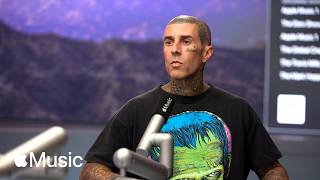
About this episodeTravis Barker discusses overcoming severe flying trauma to complete his documentary narrative, detailing how p…AI summary
Travis Barker discusses overcoming severe flying trauma to complete his documentary narrative, detailing how personal loss and survivor's guilt shaped his artistic journey. He explains his evolution from a punk drummer to a genre-defying producer, emphasizing a philosophy where drums serve as hooks and songwriting takes precedence over technical display. Barker also shares insights on parenting, the importance of analog authenticity in an AI era, and his disciplined approach to practice and collaboration.
Key takeaways 6
Overcoming Trauma as Narrative Arc: Barker initially refused to fly for his documentary due to PTSD from a plane crash, but overcame this by reframing his life as a movie where he must be the protagonist who breaks his own walls, ultimately flying to show his family they can too.
Drums as Hooks, Not Just Timekeeping: Barker’s composition philosophy treats drum parts as integral hooks (e.g., the cowbell pattern in 'Feeling This' or the Latin groove in Blink-182 songs), often prioritizing the 'feel' and simplicity of the beat over complex fills to serve the song.
Adaptive Production Style: He adapts his playing based on the artist's needs, ranging from restrained loops (for artists like XXXTentacion or Lil Peep) to high-energy punk beats, noting that he often acts as a 'closer' for songs that need finishing touches.
Analog vs. AI Stance: Barker strongly opposes AI-generated music and heavy digital editing, advocating for 'real performances' and analog sounds, predicting that the market will value raw, human-created art over polished AI content.
Songwriting Evolution: His process shifted from writing in rehearsal rooms (Blink-182's early era) to writing in the studio with a focus on beats and loops (Untitled album), allowing for more experimental structures and tempos.
Parenting as Motivation: Having children at an older age keeps him young and motivated, driving him to maintain physical health and work ethic to be an active, present father rather than just a nostalgic figure.
Notable quotes 5AI-generated: wording and quote attribution may be wrong. Use the play link to verify.
“I think the same kid when I was growing up that was like straight edge for a number of years that like didn't want to drink, didn't want to smoke... that same part of me was like flying, not flying is not going to happen.”
▶ 4:34Explaining his internal battle with flying trauma and how he used his past discipline to overcome his fear of flying.
“It's not I know how to do this cool 30 second note thing when it comes time to do a fill and I'm going to try to throw this in a song. It's never that. It's more of like what I sing to myself... and what naturally comes out when I play it.”
▶ 17:41Describing his intuitive approach to drum composition, focusing on melody and feel rather than technical showmanship.
“You have to put your ego away to be a drummer who is a songwriter... focused on telling a different sort of story than... playing music.”
▶ 28:11Discussing the mindset required for songwriting, prioritizing the song's narrative over the drummer's desire to showcase skill.
“I hate it [AI]. I'm not I'm not a fan. I think like my new rules in the studio is no autotune, no editing, little to no editing, and no drum samples... I'm leaning into just real real performances.”
Stating his firm stance against AI and digital manipulation in music production.
“It's like being a marriage... if I don't have something to do, I'm starting something... in between Blink albums, I'll write and produce three fulllength albums with whoever.”
▶ 45:15Explaining his prolific output and how he manages multiple projects alongside his primary band.
Chapters & Sections (45)▼
0:00Documentary Ending and Overcoming Flying Traumachapter1
1:57Documentary Ending and Flying Trauma
6:33Travis Barker's Personal Growth and Production Careerchapter1
8:51Travis Barker's Transition to Hip-Hop Production
11:57Drummers Musical Influences and Composition Philosophychapter2
13:41Drummers Mount Rushmore and Composition Philosophy
16:38Learning Drum Fills and Blink Grooves
18:24Learning Blink-182 Setlists and Early Studio Recordingchapter3
19:57Studio Drumming Skills and Early Recording
21:23Early DIY Recording and Songwriting Process
23:02Evolution of Blink-182 Recording Process
24:33Drumming and Songwriting Processchapter1
26:58Adapting Drumming Style to Song Needs
30:22Drumming Practice Philosophy and Physical Healthchapter1
33:07Overcoming Weaknesses and Left-Handed Drumming
35:29Recovery, Side Projects, and Legacychapter2
37:42Impact of Genre-Bending Side Projects
39:47Memories of Adam and Side Projects
42:27Jamming with Green Day and Side Projectschapter2
44:07Drummer's Creative Output vs Band Loyalty
45:46Rehearsal Jamming and Touring with Foo Fighters
48:08Blink-182 Marketing and Aquabats Originschapter2
51:36Aquabats Ambitions and 90s Ska Punk Scene
53:19Aquabats Success and Blink-182 Expectations
54:50Religion, Grief, and Music as Copingchapter2
56:46Faith, Grief, and Life Events
58:50Overcoming Survivor's Guilt Through Faith
1:00:31Music Career Longevity and Parentingchapter1
1:03:56Family Nicknames and Parenting Evolution
1:05:34Fatherhood, Kids' Music Careers, and Drumming Advicechapter3
1:08:24Authenticity and Drumming Collaboration
1:10:24Drumming Advice: Playing to a Click
1:12:00Musical Appreciation and Lil Wayne Collaboration
1:15:38Musical Collaborations and AI Stancechapter1
1:18:42Willow Smith Talent and AI Music Stance
1:20:33AI Music, Analog Nostalgia, and Rock Healthchapter1
1:23:59Travis Barker's Classic Car Collection
1:25:50Overcoming Addiction and Parenting Impactchapter1
1:27:53Remixing Lil Peep and XXXTentacion
1:31:17blink-182 Songwriting Process and Hit Creationchapter1
1:34:05Writing Non-Redundant Songs and One More Time
1:36:11Music and Fashion Synergy, Drum Gear, and Snare Selectionchapter3
 1h 13m
 1h 21m
 1h 29m⏭ 2
 1h 37m⏭ 1
 2h 9m
2h 9m 1h 6m⏭ 1
 59m
59m 1h 50m⏭ 2
 1h 2m
1h 2m 57m⏭ 2
 1h 15m⏭ 3
 1h 0m
1h 0m 1h 32m
 1h 30m
 4h 49m
 2h 41m⏭ 1
 2h 22m
 3h 18m
 1h 0m⏭ 1
 33m
33m 46m
46m 3h 54m⏭ 7
 3h 59m⏭ 5
 1h 13m
 54m⏭ 1
 58m⏭ 5
 54m⏭ 2
 25m
25m 45m⏭ 2
 1h 16m⏭ 2