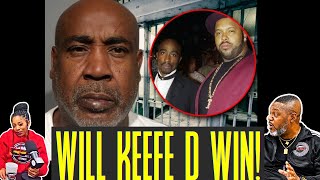
About this episodeThe defense argues that the prosecution's case against Dwayne Davis for the murder of Tupac Shakur relies enti…AI summary
The defense argues that the prosecution's case against Dwayne Davis for the murder of Tupac Shakur relies entirely on uncorroborated confessions and a fictionalized book, lacking any physical evidence or factual verification. Key points include the absence of police reports for the alleged Lakewood Mall incident, contradictions in Davis's timeline compared to eyewitness testimony, and the failure of law enforcement to verify basic details like vehicle descriptions or witness locations. The defense urges the jury to apply common sense and demand proof beyond a reasonable doubt, asserting that repeated false statements do not become facts without corroborating evidence.
Key takeaways 8
Burden of Proof and Corroboration: Under Nevada law (Instruction 42), a confession does not need corroboration only if independent evidence establishes the victim's death was caused by the defendant's criminal agency. If the jury does not believe the confession, corroboration is required. The defense argues there is no independent evidence linking Davis to the crime.
Lakewood Mall Incident Unverified: The prosecution's theory of gang retaliation hinges on a fight at Lakewood Mall between Southside Crips and Bloods. However, no police reports, security logs, or 911 calls exist for this incident. FBI agents and detectives could not verify the event occurred, relying solely on hearsay from Davis.
Contradictions in Davis's Account vs. Eyewitnesses: Davis claims he saw Tupac hanging out of a car window screaming his name. Eyewitness Leonard Jefferson testifies Tupac was sitting calmly in his seat with no fans screaming. Davis also claims to have seen Suge Knight and Tupac at the MGM the day before the fight, but Malcolm Greenish testifies Tupac did not arrive until the day of the fight.
Physical Evidence Absence: No physical evidence places Davis in Las Vegas on September 7, 1996. Searches of his home yielded only a hotel receipt with no date or location proof. No surveillance video shows him at the MGM. Phone records, DMV data, and other forensic tools failed to place him at the scene.
Vehicle Description Inconsistencies: The shooter's vehicle is described variously as a white Cadillac, cream Cadillac, Buick, or Chevy Suburban by different witnesses and officers. Crime scene analyst Dan Ford documented vehicles at the scene (BMW, Lexus, Mercedes) but found no Cadillac. The 'white Cadillac' appears in witness accounts but is absent from official crime scene documentation.
Security Failures at MGM: Reggie Wright Jr., head of security for Death Row Records, assigned only one bodyguard (Frank Alexander) to protect Tupac on the night of the murder, despite knowing Tupac was a high-profile target. Wright admitted he trusted 'Mob Piru' gangsters more than professional security or police.
Book as Fiction: The defense highlights that Davis's book contains a disclaimer assuming no responsibility for accuracy. The book misspells Davis's name (Keith vs. Kei), which he would have corrected if he had reviewed it. The book describes events (like meeting Suge at a Lakers game) that contradict known facts.
Coercion and Attorney Ethics: Detective Dupri and attorney Greg Kaden are accused of unethical behavior, including Kaden directing Davis's statements and Dupri hiding case files. The defense argues these actions coerced Davis into making false confessions to protect his family from other charges.
Notable quotes 5AI-generated: wording and quote attribution may be wrong. Use the play link to verify.
“You're not watching a movie. Your common sense and life experience as men and women of our community governs in terms of how you look at the case and what you think about the facts in the case.”
▶ 8:41Defense attorney instructing jurors to use their own judgment rather than accepting prosecution narratives blindly.
“So many people have said it. So many people have said, 'Oh, well this link with Mah incident has occurred.' Your job as jurors is very difficult. You have to sit here and weigh the evidence. But what facts do you have there?”
▶ 29:08Addressing the Lakewood Mall incident, highlighting that repeated hearsay does not constitute proof.
“If you keep asking yourself the question, you just keep lying over and over again, you keep telling the fiction, does that change it into a fact? No. You have to have supporting facts in order for a fiction to become a fact.”
▶ 1:50:06Closing argument summarizing the core defense thesis: repetition of a lie does not make it true without corroborating evidence.
“Although the authors and publisher have made every effort to ensure the accuracy and completeness of the information contained in this book, we assume no responsibility for errors, inaccuracies, omissions, or any inconsistency here.”
▶ 1:43:51Quoting the disclaimer from Davis's book to demonstrate that even the publishers do not vouch for its truthfulness.
“I trust more than I trust my security... I trust those Mob Piru guys? I do personally.”
▶ 1:29:14Reggie Wright Jr.'s testimony revealing that Death Row security trusted gang members over professional security personnel.
Chapters & Sections (47)▼
0:07Burden of Proof and Confession Corroborationchapter4
2:17Compromised Investigation and Missing Reports
5:33Compton Police Corruption and Confession Law
6:51Witness Credibility and Corroboration
8:30Direct and Circumstantial Evidence Distinction
9:59Coercion and Attorney Ethics in Confessionschapter2
12:00Voluntariness of Confessions and Attorney Influence
14:12Police Ethics and File Integrity
15:55Case File Security and Lakewood Mall Incidentchapter1
19:23Kathy Scott Book and Lakewood Mall Fight
22:16Lack of Evidence for Lakewood Mall Incidentchapter1
24:40Verifying Lakewood Mall Fight Evidence
26:43Verifying Tupac Incident and Mall Fight Claimschapter2
28:41Lack of Evidence for Foot Locker Incident
30:30Contrasting Testimony with Book Account
33:21Eyewitness Testimony vs Keefe D's Bookchapter1
35:17Keefe D's Timeline and Gun Claims
38:31Analyzing Keefe D's Book Inconsistencieschapter2
41:57Keefe D's Car Chase Account
43:18Vehicle Damage and Shooting Details
44:38Physical Evidence and Suspect Location Verificationchapter2
46:12Lack of Photo Lineup Identification
48:30Missing Las Vegas Evidence and Search Warrant
51:22Lack of Evidence Linking Davis to Tupac Murderchapter1
54:42Contradictory Testimony on Tupac's Las Vegas Arrival
56:53Inconsistencies in Keefe D's Tupac Shooting Accountchapter2
58:57Contradictions in Vehicle and Location Details
 2h 6m
2h 6m 3h 41m
 2h 31m
 1h 29m⏭ 1
 2h 8m
2h 8m 1h 22m
 2h 2m
2h 2m 2h 57m
 2h 18m
 2h 7m
2h 7m 2h 36m
 1h 53m
 4h 26m
 6h 26m
 8h 4m
8h 4m 7h 50m
 3h 57m⏭ 3
 9h 11m
 1h 51m
 1h 10m
 21m
21m 1h 3m⏭ 2
 2h 38m⏭ 1
 20m
20m 11h 23m⏭ 1
 33m
33m 1h 0m⏭ 1
 46m
46m 3h 54m⏭ 7
 3h 59m⏭ 5
 1h 13m
 54m⏭ 1
 58m⏭ 5
 25m
25m 45m⏭ 2
 1h 16m⏭ 2