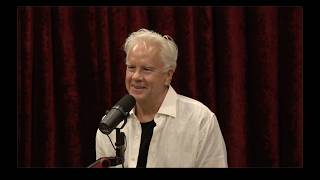
About this episodeTim Robbins discusses his career evolution from New York theater to Hollywood, highlighting the importance of …AI summary
Tim Robbins discusses his career evolution from New York theater to Hollywood, highlighting the importance of creative autonomy and the shift in industry culture. He shares specific anecdotes from iconic films like 'Top Gun', 'Howard the Duck', and 'The Player', while offering advice on handling fame and criticizing the negative impacts of media consolidation and AI on artistic integrity.
Key takeaways 5
Robbins emphasizes that maintaining creative autonomy is crucial, noting he had final cut on his three major 90s films ('Bob Roberts', 'Dead Man Walking', 'Cradle Will Rock') and now releases his own archival work independently.
He contrasts the supportive, inventive spirit of early Hollywood/West Coast with the cynical, idea-killing environment of New York, attributing his persistence to this West Coast influence combined with New York tenacity.
Robbins identifies media consolidation and AI as major threats to truth and risk-taking in content creation, arguing that AI-generated content lacks the 'soul' and human connection of live performance or practical effects.
He advocates for sustainable production schedules, praising 'Silo' for 10-hour days and respecting crew/family time, contrasting this with the industry norm of 14-16 hour days post-mergers.
Working with Robert Altman taught him the value of humility and listening to crew members to find better ideas, a principle he applies to his own directing and advice on fame.
Notable quotes 5AI-generated: wording and quote attribution may be wrong. Use the play link to verify.
“Time is my best friend. I have faith that time is my best friend.”
▶ 9:42Robbins reflecting on how films like 'Shawshank Redemption' and 'Jacob's Ladder' found their audience and legacy long after initial release.
“Arrogance... when people start considering themselves a god-given genius it all comes from through me. There's nothing more boring than someone that's stopped learning.”
Robbins discussing Robert Altman's leadership style and the importance of curiosity and humility in creative work.
“Don't believe the hype. If you believe the hype, then you're going to believe the critics... anything you've done in the past is irrelevant.”
▶ 43:19Robbins' go-to advice for handling fame and success, emphasizing that each new project requires fresh effort regardless of past achievements.
“The democratization. I mean, you can with less make more... this is why I'm doing my website.”
▶ 4:44Robbins explaining his decision to launch his own website to archive and release his independent films and theater work directly.
“Give me a blank stage, eight good actors, and a piece of material, and I will make magic for you. I know how to do that.”
▶ 1:02:52Robbins asserting the irreplaceable value of live theater and human imagination over AI-generated content.
Chapters & Sections (36)▼
0:00Comic-Con Experience and Film Industry Evolutionchapter4
2:29Star Wars Cultural Impact and Organic Moments
4:17Directing Career Shift and Independent Archive
6:15Continuous Creative Work and Project Transition
7:50Creative Autonomy and Long-term Film Legacy
9:50New York Upbringing and Hollywood Career Evolutionchapter2
12:33Actors Gang founding principles and punk rock spirit
14:59Hollywood Career Evolution and Respect
17:42Quint and Hule Sponsorships and Top Gun Memorieschapter2
19:41Hule Sponsorship and Top Gun Audition
21:25Top Gun Production and Howard the Duck
24:14Howard the Duck and Bull Durham Castingchapter3
25:29Howard the Duck Production Challenges
27:06Rough Day in Duckland and Bull Durham Audition
30:02Jacob's Ladder and Time's Effect
32:33Jacob's Ladder Influence and Robert Altman Collaborationchapter1
34:52Rula Therapy Ad and Robert Altman Collaboration
37:48Bob Roberts collaboration and Jack Black discoverychapter1
39:59Curiosity and Jack Black's Early Career
42:44Handling Fame and Hudsucker Proxy Castingchapter3
45:01Auditioning for Hudsucker Proxy
46:21Shawshank Redemption Cinematography and Legacy
 48m⏭ 1
 47m
47m 57m⏭ 2
 1h 10m⏭ 1
 44m⏭ 1
 51m⏭ 1
 57m⏭ 1
 50m⏭ 3
 45m⏭ 2
 59m⏭ 2
 1h 0m⏭ 2
 1h 5m⏭ 3
 1h 20m
 2h 35m⏭ 2
 1h 0m
1h 0m 32m
32m 40m
40m 1h 10m
 2h 30m⏭ 2
 2h 34m
 1h 10m
 1h 45m⏭ 2
 1h 13m
 1h 53m
 11h 23m⏭ 1
 33m
33m 1h 0m⏭ 1
 46m
46m 48m⏭ 2
 3h 54m⏭ 7
 3h 59m⏭ 5
 1h 16m
 54m⏭ 1
 1h 13m
 38m
38m 54m⏭ 2