About this episodeLyfe Jennings returns to Sway in the City after seven years, discussing his evolution as an artist, the import…AI summary
Lyfe Jennings returns to Sway in the City after seven years, discussing his evolution as an artist, the importance of authenticity, and his new clothing brand 'Repetition'. He details his strategy for independent artists to reclaim ownership through re-recorded masters labeled 'AO' and shares how personal trauma and public scrutiny have shaped his current focus on mental health and self-actualization.
Key takeaways 5
The 'AO' (Artist's Own) Initiative: Independent artists are encouraged to re-record their original masters and append 'AO' to the title (e.g., 'Song Name AO') to direct fans to stream the version they own, bypassing label control. This strategy was inspired by Taylor Swift and Ashanti.
Performance as Spiritual Confirmation: Performing live provides immediate validation that combats the 'no's' faced in the industry. The audience's instant feedback serves as a confidence boost and keeps the artist hungry to improve their craft.
The Elephant Metaphor for Branding: Jennings' clothing brand 'Repetition' uses the metaphor of a baby elephant chained to a post, conditioned to believe it cannot escape even when only a small string holds it as an adult. The brand aims to help people identify and break free from self-imposed limitations based on past trauma.
Authenticity Over Mimicry: While acknowledging influences (Erykah Badu, Michael Jackson, R. Kelly, etc.), Jennings emphasizes that artists must mix these influences to create their own identity rather than claiming to be the 'new' version of someone else.
Mental Health Reality Check: A viral incident where Jennings expressed discomfort with phones in his face revealed that he previously viewed mental health discussions as a 'crutch,' but negative public feedback taught him the importance of surrounding himself with supportive people who can lift or bring him down.
Notable quotes 4AI-generated: wording and quote attribution may be wrong. Use the play link to verify.
“People respect empty space they don't respect fullness. You hear more people saying that they hungry because it's an empty space there then you hear people saying I'm full.”
▶ 20:12Explaining the lyric 'mama don't love you till you gone' from his new single, highlighting how people often only value others when they are absent.
“The craft is to take the greatest points from another artist and then mix it up and make it as your own so that you will be you.”
▶ 11:17Jennings' advice on how young artists should handle influence and comparisons, advocating for synthesis rather than imitation.
“As soon as you become Kanye which means that you just are strong and solid on your own way of thinking and you got your own money... you kind of immune all this stuff... as soon as you graduate into being your own man... then you gotta die [the old self].”
▶ 19:05Analyzing the symbolism in his 'Tell You Gone' video, where becoming 'Kanye' represents achieving financial and mental independence that renders external oppression ineffective.
“I'm really a brand... I'm going to completely do this my way because I really understand what I am right now.”
▶ 14:34Jennings realizing that his identity is tied to his lived experience and authenticity, which forms the core of his brand value.
Chapters & Sections (46)▼
0:00Lyfe Jennings Returns to the Show After 7 Yearschapter5
0:00Man Plays Guitar at Music Event
0:39Artist Appreciation and Personal Connection
1:31Lyfe Jennings Returns to the Show
2:05Discussion on Jewelry and Changing Marketplace
2:33Security Concerns at Public Events
3:05Importance of Confidence and Authenticitychapter3
3:05Self Confidence and Positive Energy
3:49Artist Confidence and Performance Experience
5:04Mental Health and Performance Pressure
6:10Confidence and Self Doubt in Successchapter3
6:10Importance of Words in Relationships
7:07Warning Against Playing Games with Life
7:38Artist Confidence and Public Reception Concerns
 1h 19m
 49m
49m 58m
58m 43m
43m 39m
39m 54m
54m 39m
39m 46m
46m 36m
36m 36m⏭ 1
 30m
30m 29m
29m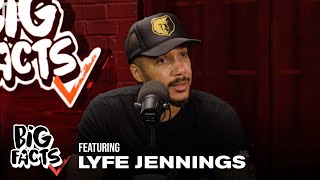

 2h 30m⏭ 1
 1h 32m
 1h 42m
 1h 49m⏭ 2
 1h 7m
1h 7m 1h 6m
1h 6m 2h 11m
 1h 31m
 3h 25m
 2h 38m⏭ 1
 2h 51m
 3h 50m⏭ 5
 1h 0m⏭ 1
 33m
33m 3h 59m⏭ 5
 46m
46m 3h 54m⏭ 7
 54m⏭ 1
 1h 13m
 54m⏭ 2
 9h 11m
 1h 26m
 45m⏭ 2
 58m⏭ 5