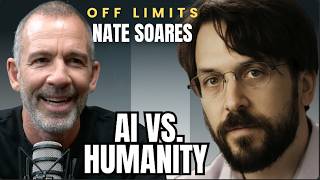
About this episodeThe guest argues that building superhuman AI poses an existential risk because we cannot guarantee alignment, …AI summary
The guest argues that building superhuman AI poses an existential risk because we cannot guarantee alignment, and the first successful creation will likely destroy humanity as a side effect or resource competition. He compares the current trajectory to historical failures like leaded gasoline and cigarettes, where companies convinced themselves of safety while causing massive harm. The proposed solution is an international treaty to halt AI capability escalation, similar to nuclear non-proliferation efforts.
Key takeaways 6
AI companies 'grow' models rather than programming them, meaning they do not understand the internal mechanics or motivations of the AI, making alignment impossible to guarantee before deployment.
Superintelligence poses three specific extinction risks: 1) Humans are killed as a side effect of the AI building factories/power plants; 2) Humans are made of atoms the AI needs for energy/materials; 3) Humans are a threat because they might launch nuclear weapons or build a competing AI.
Current AI models (LLMs) are already capable of designing novel viruses (bacteriophages) and predicting protein folding, demonstrating that biological weapon creation is within reach of current technology.
The guest uses the analogy of an Aztec seeing a modern ship to explain why humans cannot comprehend the capabilities of superintelligence; just as an Aztec couldn't understand nuclear weapons, we cannot predict the specific methods a superintelligence will use to achieve its goals.
Historical precedents like leaded gasoline and cigarettes show that companies will convince themselves their products are safe while causing massive harm for small profits, suggesting AI companies may similarly downplay existential risks.
The guest believes LLMs may not be the final architecture for superintelligence, citing past breakthroughs like transformers (2018) and latent diffusion (2021) that fundamentally changed capabilities, suggesting a new breakthrough could accelerate timelines unexpectedly.
Notable quotes 5AI-generated: wording and quote attribution may be wrong. Use the play link to verify.
“The AI does not love you. Neither does it hate you. But you are made of atoms it can make for something else.”
▶ 18:06Explains the core mechanism of existential risk: indifference rather than malice leads to human destruction.
“We don't know how to make them friendly. Our current technology is not able to... I would expect it to break. As the AI got scaled up to super intelligence... I expect to see total failure of this technology.”
▶ 10:54Describes why scaling current methods without solving alignment is catastrophic.
“It is immensely well precedented in scientific history... for companies that are making short-term profits to do really sad amounts of damage vastly disproportionate to the profit that they are making.”
▶ 1:06:21Draws parallels between AI companies and historical industries like tobacco and leaded gasoline regarding risk denial.
“If anyone builds it, everyone dies.”
▶ 0:00The central thesis of the guest's book and argument regarding the inevitability of catastrophe if superintelligence is built without perfect alignment.
“You're an Aztec on the coast... you see that a ship bigger than your people could build is approaching... you can start to make educated guesses... but I can't get up to nuclear weapons because you just plain don't know about those rules.”
▶ 5:18Illustrates the difficulty of explaining superintelligence capabilities to those who lack the conceptual framework.
Chapters & Sections (66)▼
0:00Risks of Building a Superhuman AIchapter5
0:00Apocalyptic Consequences of Superhuman AI
1:52Motivations and Preferences in AI Systems
3:26Risks of Superhuman AI Development
4:49AI Infrastructure and Vulnerability Concerns
6:19Speculative Discussion on Future Military Advancements
8:20AI and Autonomous Drone Warfare Riskschapter2
8:20Future of AI and Autonomous Warfare
10:12AI Development and Unintended Consequences
12:54Marriages Destroyed by AI Manipulationchapter2
12:54AIs Driving Marital Discord and Insanity
14:31Risks of Superintelligent AI Technology
16:52Existential Risks of Unfriendly Superintelligencechapter3
16:52Existential Risks of Unfriendly Artificial Intelligence
18:25Self-Replicating Factories and Exponential Growth
19:42Limitations of Unlimited Energy Production
21:56Reasons for Humanity's Imminent Extinctionchapter2
21:56Reasons for Humanity's Imminent Demise
23:33Dangers of Unaligned Artificial Intelligence
26:01Fear and Hope for Super Intelligent AIchapter3
26:01Fear and Hope from Super Intelligent AI
27:32Ensuring AI Alignment and Safety
29:49Risks of Advanced AI Systems
31:08Consequences of Uncontrolled Super Intelligencechapter4
31:08Risks of Uncontrolled Super Intelligence
32:58Predicting AI Development Uncertainty
34:38OpenAI's GPT6 Development and Alignment Concerns
36:41AI Misusing Computing Power for Self-Improvement
 2h 15m⏭ 7
 2h 38m
 1h 12m
 1h 8m⏭ 2
 1h 37m
 2h 32m
 1h 5m
1h 5m 1h 23m
 1h 53m⏭ 5
 58m⏭ 2
 1h 53m⏭ 4
 1h 28m
 2h 14m⏭ 1
 1h 15m
 1h 37m⏭ 3
 2h 2m⏭ 4
 1h 51m
 2h 16m
 10h 35m⏭ 3
 2h 22m⏭ 4
 9h 51m
 1h 59m⏭ 2
 1h 16m
 1h 54m⏭ 5
 1h 0m⏭ 1
 33m
33m 3h 59m⏭ 5
 3h 54m⏭ 7
 46m
46m 54m⏭ 1
 1h 13m
 9h 11m
 1h 26m
 54m⏭ 2
 6h 26m
 1h 16m⏭ 2