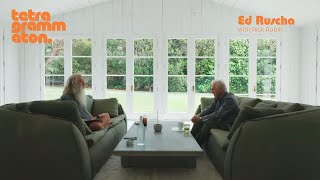
About this episodeFilmmaker Roger Avary recounts his journey from struggling indie creator to Hollywood success and subsequent p…AI summary
Filmmaker Roger Avary recounts his journey from struggling indie creator to Hollywood success and subsequent prison sentence following a fatal car accident, detailing how this trauma reshaped his philosophy on forgiveness and creativity. He shares his unique writing process involving a visual 'tunnel' hallucination, his critique of modern media's reliance on violence, and his spiritual awakening through the TV show 'The Chosen'.
Key takeaways 5
The 'Tunnel' Visualization: Avary describes a lifelong creative process where he visualizes a gray, fabric-like tunnel; he mentally enters it to watch the movie play out in real-time, transcribing the dialogue and action as if he is merely recording what he sees.
Prison as a Catalyst for Wisdom: Avary reframes his incarceration not as a punishment but as a 'blessing' (from the French 'blessure', meaning wound) that stripped away his material possessions and forced him to discover his true self and purpose.
Critique of Modern Media: He argues that contemporary television and film rely on 'revenge' and gratuitous violence to manipulate audience serotonin levels, contrasting this with the harder, more masterful art of portraying forgiveness.
The 'SPEC' Technique: Avary advocates for a specific manifestation method: Select what you want, Project it visually, Expect it to happen, and Collect it into reality through persistent belief and action.
Authenticity in Acting: He emphasizes that untrained actors often provide more truth than professionals because they cannot fake emotions; he successfully directed an untrained actress by having her experience real grief rather than acting it out.
Notable quotes 5AI-generated: wording and quote attribution may be wrong. Use the play link to verify.
“A blessing is not something that is good that happens to you. It's something that wounds you and through that you find wisdom and that is the blessing.”
▶ 18:07Avary explaining the etymology of 'blessing' and how his prison experience provided him with wisdom despite the tragedy.
“When you're a writer and you allow characters to inhabit you. It's a kind of possession... I don't write the dialogue. I listen to the dialogue and I just try to transcribe it.”
▶ 24:46Describing his unique writing process where he feels possessed by the characters and hears their voices.
“The persistent are the generally the successful ones... You have to be persistent. This is where most people fail... Most people will turn around and go back to what's comfortable.”
▶ 1:45:35Avary's advice on perseverance in Hollywood, noting that talent is less important than the willingness to walk through the 'tunnel' of uncertainty.
“If they watch something and they see peace portrayed, if you watch Little House in the Prairie, you're going to copy Little House in the Prairie. If you watch, you know, uh, extreme violence, you're going to copy violence.”
▶ 56:48Avary's theory on how media influences reality and societal behavior.
“Jesus is SoCal punk rock... The system. Yeah. And so that was me 100%... I hate hypocrisy. It makes me enraged.”
▶ 1:03:24Avary connecting his punk rock upbringing to his interpretation of Jesus as an anti-hypocrisy figure in 'The Chosen'.
Chapters & Sections (48)▼
0:06Developing Beowulf Script with Neil Gaimanchapter4
2:24Leaving Sandman Project and Beowulf Vision
3:59Beowulf Script Development and Image Movers
6:01Vision and Financing Challenges for Beowulf
7:44Declining Silent Hill Offer to Direct Beowulf
10:41Financial Success, Identity Crisis, and Car Accidentchapter2
13:12Collaborative Filmmaking and Sudden Wealth
15:07Car Crash and Incarceration Aftermath
17:29Prison Solitude and Existential Reflectionchapter1
20:20Solitary Confinement and Legal Aftermath
22:44Writing Process and Character Truthchapter2
24:36Writing as Possession and Transcription
26:20Submersible Modules and Writing Flow
29:41The Tunnel Visualization and Creative Processchapter1
31:23Autobiography Through Biographical Subjects
33:57Prison Writing and Prisoner Dynamicschapter2
36:37Prison as Existential Prison and Social Order
38:32Prison Violence and Perceived Time
40:17Prison, Freedom, Dreams, and Timechapter1
43:35Prison Society and Gratitude for Freedom
45:37Prison Spirituality and Buddhist Liberationchapter3
47:21Buddhism, Stoicism, and Inner Freedom
49:54Vegetarian Meals and Buddhist Practice in Prison
51:43Jesus Films and Resurrection Themes
53:27Media Violence Impact and Forgivenesschapter1
56:40Media Influence and The Chosen's Message
59:38The Chosen, Punk Rock, and Forgivenesschapter1
1:01:59The Chosen, The Martian, and Punk Rock
1:04:50The Prisoner TV Show and Political Polarizationchapter2
1:07:06The Prisoner's Impact and Moral Philosophy
1:08:31Group Dynamics and Political Polarization
1:12:17Prison, Dostoevsky, and Inner Freedomchapter2
1:14:02Human Adaptability and Camaraderie in Prison
1:15:56Human Kindness and Inner Freedom
1:18:58Cinematic Communion and Formative Film Experienceschapter1
1:21:34Video Libraries and Formative Movies
1:24:19The Sound of Music Analysis and Filmmakingchapter2
1:26:33Intermission Symbolism and Script Importance
1:28:17Filmmaking as Adaptive Problem Solving
1:29:42Embracing Chaos and Truth in Filmmakingchapter2
1:32:02Shannon's Authentic Reaction to the Scene
1:33:27Adapting to Truth and Avoiding Excess
1:37:12Budget Constraints, Film Evolution, and Faithchapter1
1:39:47Changing Perspectives on Blade Runner and Faith
1:42:08Visualization, Passion, and Persistence in Manifestationchapter3
1:44:45The Three Ps: Passion, Visualization, Persistence







 1h 49m⏭ 2
 2h 20m⏭ 1
 20h 40m⏭ 10
 1h 8m
1h 8m 2h 15m
 1h 10m
 1h 47m
 15m
15m 1h 58m⏭ 6
 1h 59m⏭ 3
 1h 52m⏭ 3
 40m
40m 1h 0m⏭ 1
 33m
33m 3h 59m⏭ 5
 46m
46m 3h 54m⏭ 7
 54m⏭ 1
 1h 13m
 9h 11m
 1h 26m
 54m⏭ 2
 6h 26m
 58m⏭ 5