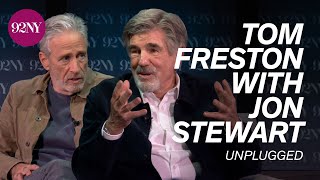
About this episodeTom Freston shares his journey from a counterculture youth working menial jobs in ski resorts to building MTV …AI summary
Tom Freston shares his journey from a counterculture youth working menial jobs in ski resorts to building MTV into a global media empire. He details how leveraging 'middle America' markets, bypassing gatekeepers through fan mobilization, and hiring inexperienced but creative individuals allowed MTV to revolutionize television. The narrative also covers his later years at Viacom, the complexities of corporate leadership under Sumner Redstone, and his reflections on how creativity thrives in entrepreneurial environments but often fades when absorbed by large public corporations.
Key takeaways 5
MTV's initial success relied on targeting 'middle America' cable markets (e.g., Tulsa, Des Moines) where they had no competition, rather than major cities like NY or LA which lacked cable infrastructure at the time.
The 'I Want My MTV' campaign was a masterclass in bypassing gatekeepers by mobilizing the end-user (fans) to pressure cable operators, directly inspired by the 'I Want My Mappy' campaign.
Hiring people with 'no experience' in a specific field (like television) can be a strategic advantage for innovation, as it prevents preconceived notions from limiting creative solutions.
MTV's visual identity was deliberately designed to be non-static and rule-breaking, using full-cell animation and changing logos to signal that the network was different from traditional broadcast TV.
Comedy Central was launched reactively to block HBO's entry into basic cable comedy, demonstrating how rapid, improvised strategic moves can create billion-dollar assets even without a fully formed initial plan.
Notable quotes 4AI-generated: wording and quote attribution may be wrong. Use the play link to verify.
“"Innovation was finding things that existed already and putting them together in a new way. It wasn't like an invention."”
▶ 8:01Freston explains his definition of innovation learned from professor Peter Drucker, which became central to MTV's strategy.
“"We're looking for people with no experience in television... We can't afford to pay people who... from NBC or ABC."”
▶ 21:53Bob Pitman explains why they hired Freston and others without TV experience, allowing them to think outside traditional broadcast norms.
“"It's all about ego... You're petty. You want to get credit for everything is is the butt."”
▶ 52:49Freston describes the toxic dynamics that led to the firing of Frank Biondi and eventually himself at Viacom.
“"The problem has been is companies that existed like that... got gobbled up into these rollups... A lot of the creative cultures kind of tended to fade away because the places that had them that we knew got assimilated into larger public companies."”
▶ 1:33:22Insight on how corporate consolidation destroys the nimble, creative cultures necessary for innovation.
Chapters & Sections (42)▼
0:05Counterculture Lifestyle and 1960s New York Citychapter3
2:151960s Cultural Shift and Ski Bum Lifestyle
3:381960s New York Counterculture and Greenwich Village
6:00New York City Gentrification and Draft Avoidance
7:40Academic Influence and Early Career Travelschapter1
10:38Ad Agency Work and Sahara Journey
12:45Hitchhiking and Business in India and Afghanistanchapter1
15:35Life in India and Afghanistan Coup
18:38Smuggling, Career Pivot, and MTV Foundingchapter1
20:30Career Pivot to MTV Using Transferable Skills
23:33MTV Launch and Early Cable Expansionchapter1
25:35MTV's Middle America Cable Expansion
28:30MTV's I Want My MTV Campaign and Industry Relationschapter2
31:22MTV's Legal Battles and Live Aid Broadcast
32:49MTV's Expansion into Hip Hop and Global Markets
34:32MTV Culture and Creative Leadershipchapter1
36:07MTV's Creative Leadership and Culture
39:31MTV's Impact on Music and TVchapter3
41:20Music Videos Transform Music Business
42:57MTV's Evolution Beyond Music Videos
45:16Birth of Reality TV and Live Events
48:10Viacom Acquisition and Management Conflictchapter1
51:39Viacom CEO Ego and Frank Biondi Firing
53:11MTV's Unplugged and Brand Identitychapter1
56:12MTV's Origin and Creative Branding
59:12MTV Network Evolution and Corporate Strategychapter2
1:01:48Viacom Split and Legacy Media Challenges
1:03:12Critique of MTV's Conglomerate Strategy
1:04:37Acquisitions and the Comedy Warschapter2
1:06:35Strategic Comedy Channel Announcement
1:08:19Comedy Central Formation and South Park Launch
1:10:18Comedy Central Success and Afghanistan Media Ventureschapter1
1:12:19Returning to Afghanistan for Media Ventures
1:15:10MySpace Acquisition and Paramount Leadershipchapter1
1:17:12Hiring Brad Gray and Acquiring DreamWorks
1:20:16Firing, Reflections, and MTV Sesame Street Comparisonchapter1
1:22:49Lessons on Experience and MTV Sesame Street Comparison
1:25:34Entrepreneurial Spirit and Vice Media Partnershipchapter1
1:28:31Vice Media's Early Gonzo Content and Funding
1:30:56Corporate Culture Impact on Creativitychapter2

 1h 36m
 1h 10m
 2h 27m
 2h 28m⏭ 1
 2h 49m⏭ 1
 1h 21m⏭ 1
 1h 37m⏭ 3
 3h 1m⏭ 4
 2h 26m⏭ 3
 2h 52m⏭ 1
 2h 19m⏭ 4
 38m⏭ 1
 11h 23m⏭ 1
 33m
33m 1h 0m⏭ 1
 46m
46m 3h 54m⏭ 7
 3h 59m⏭ 5
 1h 13m
 54m⏭ 1
 58m⏭ 5
 25m
25m 45m⏭ 2
 1h 16m⏭ 2