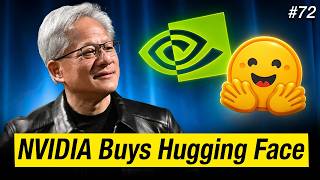
About this episodeThe discussion centers on Nvidia's aggressive ecosystem investment strategy, highlighted by the $6 billion acq…AI summary
The discussion centers on Nvidia's aggressive ecosystem investment strategy, highlighted by the $6 billion acquisition of Perplexity's Model Factory, which underscores the extreme capital intensity of frontier AI model development. The speakers analyze the competitive pressures facing OpenAI as it prepares for its IPO, noting that Anthropic's superior growth and profitability have forced OpenAI to accelerate its public listing timeline. Finally, the conversation explores the emerging challenge for enterprises to manage 'token addiction' and allocate AI compute costs effectively as a finite financial resource.
Key takeaways 5
Nvidia's acquisition of Poolside's Model Factory for $6 billion demonstrates that even failed standalone ventures in hyper-growth markets can yield significant returns if they move the ball forward for a larger acquirer with superior capital access.
OpenAI is forced to go public in 2027 not just due to capital needs, but because Anthropic has overtaken it in growth trajectory and profitability, creating an 'absence of choice' scenario where delaying an IPO risks further market share erosion.
The venture capital 'gravy train' has effectively ended for frontier model development; only hyperscalers (Microsoft, Google, Amazon, Nvidia) possess the balance sheets required to finance state-of-the-art models, leaving traditional VCs as minor players in this specific segment.
Enterprises are entering a phase of 'token addiction' where AI usage is becoming essential for productivity, forcing CFOs to treat compute costs like capital—requiring strict allocation and budgeting rather than unlimited access.
The market is shifting from closed-source dominance to a multi-model ecosystem where open-weight models are capturing significant token volume, creating pressure on closed-source providers to justify premium pricing through brand and security.
Notable quotes 5AI-generated: wording and quote attribution may be wrong. Use the play link to verify.
“If you get 15x on your failures and eventually you'll die a rich man.”
▶ 0:05Guest discussing the high returns generated even when a venture like Poolside fails to achieve its original thesis but is acquired by Nvidia.
“It's all about code. That's the only sales that matter.”
▶ 0:33Host emphasizing that coding is currently the highest ROI and fastest adopting market for AI integration, surpassing consumer applications.
“If 30% of my company leaves to go work for Harvey, I'm dead in the water.”
▶ 0:36Guest highlighting the existential risk for traditional companies regarding talent retention as AI agents become more capable.
“Silicon Valley forgets every 3 years that the average American is not trying to be efficient.”
▶ 0:40Guest critiquing the over-focus on personal productivity tools (like inbox management) while ignoring that most users do not seek maximum efficiency.
“If danger can be described as the absence of choice... that's how you know you're in danger.”
▶ 34:58Guest quoting a book to explain OpenAI's forced hand in announcing its IPO timeline due to competitive pressure from Anthropic.
Chapters & Sections (39)▼
0:00Nvidia Acquires Perplexity Model Factorychapter2
2:25Capital Intensity and Frontier AI Competition
4:22AI Startup Exits and Capital Risks
6:12Nvidia Open Source Strategy and Seed Investment Returnschapter2
8:43Hyperscalers Finance Frontier AI Models
10:54Seed Investment Math and Frontier Model Valuations
 1h 19m
 1h 49m⏭ 1
 1h 32m
 1h 8m
1h 8m 1h 3m
1h 3m 1h 36m
 1h 29m
 1h 20m
 1h 4m⏭ 2
 1h 5m⏭ 1
 53m
53m 35m
35m 1h 10m⏭ 2
 1h 30m⏭ 1
 1h 53m⏭ 2
 5h 6m⏭ 1
 1h 44m
 2h 5m⏭ 7
 4h 10m⏭ 2
 1h 40m⏭ 2
 2h 28m⏭ 2
 37m
37m 1h 0m⏭ 1
 33m
33m 46m
46m 3h 54m⏭ 7
 3h 59m⏭ 5
 1h 13m
 54m⏭ 1
 54m⏭ 2
 58m⏭ 5
 25m
25m 45m⏭ 2
 1h 16m⏭ 2