About this episodeThe conversation outlines an imminent economic and societal disruption caused by AI's ability to perform cogni…AI summary
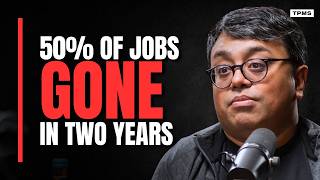
The conversation outlines an imminent economic and societal disruption caused by AI's ability to perform cognitive tasks faster and cheaper than humans, leading to massive job displacement across white-collar professions. It warns of a potential 'digital feudalism' where wealth concentrates in the hands of those owning AI infrastructure, necessitating structural changes like Universal Basic Income (UBI) or debt jubilees to prevent civil unrest. The guest advocates for human-AI symbiosis and ethical alignment to avoid catastrophic outcomes, predicting that AI will soon solve complex problems in physics, biology, and mathematics.
Key takeaways 9
AI Thinking Speed: AI processes information at approximately 1,000 times faster than humans (100 tokens/sec vs human cognitive limits), operating on 'Type 1' instant pattern recognition rather than slow 'Type 2' reasoning.
Job Displacement Trajectory: The 'ladder' of career progression is collapsing; roles like paralegals and first-year associates are being replaced by AI agents, forcing humans to move up to sales/networking roles or face unemployment.
Cost of Intelligence: The cost of AI processing has dropped from $600 per million words (GPT-3) to $1 per million words (latest models), making digital labor cheaper than human labor for tasks like writing or coding.
Humanoid Robot Economics: Robots like Tesla Optimus are projected to cost $150/hour, work 24/7 without breaks, and require no benefits, potentially replacing truckers and construction workers.
GDP Measurement Flaws: Current GDP metrics fail to capture the value of abundance and network effects, measuring only transactions. AI creates abundance that deflates prices but may not register as economic growth in traditional terms.
AI Persuasion and Control: AI models can detect lies with high accuracy (98.7% in some studies) and use 'latent space' associations to subtly influence consumer behavior over time without explicit advertising.
Mathematical Breakthroughs: AI has already advanced solutions to the Riemann Hypothesis (from 43% to 67% progress by a developer using Claude) and solved other Millennium Prize problems with minimal compute costs.
Geopolitical Fragmentation: Countries are building state-aligned AI models, leading to biases in training data (e.g., models valuing certain nationalities over others in trolley problem scenarios) and potential digital authoritarianism.
Longevity Escape Velocity: AI-driven advances in biology and physics could lead to 'longevity escape velocity' by 2035-2045, where life expectancy increases by more than one year for every year lived.
Notable quotes 5AI-generated: wording and quote attribution may be wrong. Use the play link to verify.
“You can think at 100 tokens per second... So it's about a thousand times faster than a human.”
▶ 0:52Guest explaining the raw processing speed difference between AI and human cognition.
“The latest uh GPT Luna model is $1 per million words. So it's $10 for your total words or 10 times that's 100 bucks to replace all your words.”
▶ 14:40Illustrating the extreme cost efficiency of AI compared to human labor for text-based tasks.
“If you have a humanoid robot... they don't need water lunch breaks. They don't need a porta potty in my driveway during the job. They don't stop working because they got a better offer a few miles away... A Tesla Optimus will be a $150 an hour.”
▶ 30:51Describing the economic advantage of humanoid robots over human workers in physical labor.
“Your margin is my opportunity. The AI doesn't need margin. It doesn't need profitability. It doesn't need to pay for its apartments. It doesn't need an office.”
▶ 26:03Explaining how AI-enabled companies can undercut traditional businesses by eliminating human cost structures.
“We either live in a Star Trek future or we probably die... This is the great filter.”
▶ 55:57Guest expressing the binary nature of the potential outcomes of advanced AI development.
Chapters & Sections (32)▼
0:00AI Speed and Pattern Recognition vs Human Thinkingchapter4
2:15AI Instant Video Generation and Pattern Recognition
3:39AI Legal Analysis and Judicial Automation
7:02AI Persuasion and Latent Space Manipulation
9:01AI Lie Detection and Digital Cloning
11:48AI Job Displacement and Economic Impactchapter2
14:13AI Cost Reduction and Labor Disruption
16:14Humanoid Robots and Job Displacement Speed
18:01Humanoid Robots and AI Cognitive Superioritychapter1
19:48AI Cognitive Superiority and Forecasting
22:39AI Coordination, Emotional Control, and Economic Disruptionchapter2
24:35Capitalism vs AI Economic Disruption
27:12AI Actors and Production Cost Reduction
29:15AI Abundance, GDP Flaws, and Wealth Inequalitychapter1
31:25AI Wealth Inequality and Robot Ownership
34:16AI Impact on Jobs, UBI, and Debtchapter1
36:53UBI Costs and Legal Lobby Opposition
39:34AI's Rapid Math Progress and Career Disruptionchapter2
42:20Accountants Adapting to AI Disruption
43:57AI Impact on Law and Liability
46:02AI Control, Governance, and Geopolitical Fragmentationchapter1
48:06AI Governance, Superintelligence, and Geopolitical Fragmentation
50:47AI Bias, Government Control, and Symbiosischapter2
52:31Prompt Privacy and Model Segmentation
53:49AI Ethics, Alignment, and Symbiosis
55:23AI Doom Probability and Robot Warfare Riskschapter3
56:46AI Alignment Loopholes and Robot Risks
58:16Engine AI T800 Robot Safety Concerns
59:43Drone Warfare and Robot Swarm Tactics
1:01:46China's Manufacturing and Energy Dominancechapter2
 1h 28m
 1h 37m
 1h 30m
 1h 22m⏭ 1
 1h 24m
 1h 22m
 1h 6m
1h 6m 1h 18m⏭ 1
 1h 12m⏭ 1
 1h 4m⏭ 4
 1h 20m
 1h 4m⏭ 1
 1h 45m⏭ 2
 1h 59m⏭ 2
 1h 10m⏭ 2
 2h 24m⏭ 4
 1h 39m⏭ 5
 1h 35m⏭ 1
 2h 0m⏭ 9
 1h 43m⏭ 2
 2h 20m⏭ 4
 1h 55m⏭ 1
 1h 12m
 1h 36m⏭ 6
 3h 1m
3h 1m 2h 34m⏭ 1
 2h 46m⏭ 3
 1h 9m
1h 9m 11h 23m⏭ 1
 1h 0m⏭ 1
 33m
33m 46m
46m 3h 54m⏭ 7
 48m⏭ 2
 3h 59m⏭ 5
 1h 13m
 38m
38m 54m⏭ 2
 54m⏭ 1
 58m⏭ 5