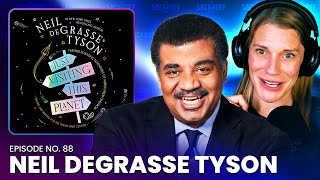
About this episodeNeil deGrasse Tyson discusses his book 'Starry Messenger,' arguing that scientific literacy and the ability to…AI summary
Neil deGrasse Tyson discusses his book 'Starry Messenger,' arguing that scientific literacy and the ability to distinguish objective truth from personal belief are critical for a functioning democracy. He highlights how cognitive biases, particularly regarding probability and pattern recognition, make humans vulnerable to exploitation by industries like gambling and misinformation campaigns. Tyson advocates for teaching the scientific method as a living process of inquiry rather than just memorizing facts, emphasizing that nature is the ultimate judge of ideas.
Key takeaways 6
Objective Truth vs. Personal Truth: Objective truths are established by observation and experiment and are true regardless of belief (e.g., Earth is round). Personal truths (e.g., religious beliefs) are protected but cannot be forced on others without violence, which leads to conflict. Science provides tools to establish objective truths, while schools often fail to teach the process of how confidence in facts is built.
Cognitive Bias in Probability: Humans are ill-equipped to understand probability and statistics, leading to errors like the 'gambler's fallacy' (believing a number is 'due' at a roulette table). This cognitive weakness is exploited by the casino industry and state lotteries, which profit from public misunderstanding of odds.
Pattern Recognition Overdevelopment: Humans have an overdeveloped urge to find patterns and meaning in coincidences (e.g., 'small world' encounters). This bias makes people susceptible to pseudoscience and conspiracy theories because they ignore the statistical likelihood of random events.
Misapplication of Science in Social Issues: Fields like 19th-century anthropology were highly susceptible to bias, leading to racist pseudoscience that justified colonialism and eugenics. Tyson illustrates this by hypothetically reversing the roles to show how easily 'scientific' arguments can be fabricated to support pre-existing prejudices.
Self-Correcting Systems: Tyson suggests that society has self-correcting mechanisms; for example, if climate change deniers lose their beachfront property to rising seas, they may become convinced by the evidence. However, he warns against waiting for such catastrophic corrections.
Cosmic Perspective: Viewing Earth from space (the 'Overview Effect') removes geopolitical boundaries and highlights the fragility of our planet, fostering a sense of unity and reducing the likelihood of conflict among those who adopt this perspective.
Notable quotes 5AI-generated: wording and quote attribution may be wrong. Use the play link to verify.
“Objective truths are true whether or not you believe in them. Ultimately nature is the judge, jury, and executioner of your ideas.”
Tyson explains the fundamental difference between subjective beliefs and facts established by the scientific method.
“The entire city of Las Vegas exists because of this shortcoming of our thinking... we are so diabolical as a species that there are people who know how bad we are at probability and statistics that they know it so well that they created entire industries to exploit that failure.”
▶ 23:13Discussing how casinos and lotteries profit from human inability to understand random probability.
“The Bible tells you how to go to heaven, not how the heavens go.”
▶ 51:48Quoting Galileo to illustrate the separation between religious faith and scientific inquiry.
“Do whatever it takes not to fool yourself into thinking that something is true that is not, or that something is not true that is.”
▶ 53:10Tyson's summary of the core principle of the scientific method.
“I write these futures [apocalyptic scenarios] so that you will know to avoid them.”
▶ 59:01Ray Bradbury's explanation for writing science fiction, shared by Tyson to highlight the value of warning narratives.
Chapters & Sections (70)▼
0:05Neil deGrasse Tyson's Book and Career Discussionchapter2
0:05Astrophysicist Neil deGrasse Tyson Discusses His Work
3:24Challenging Misconceptions with Science and Perspective
5:51The Intersection of Science and Civilizationchapter3
5:51The Intersection of Science and Civilization
7:33The Dangers of Misinformation and Ignorance in Society
8:57Coping with Misinformation and Unfounded Ideas
10:15Challenging Personal Truths in a Pluralistic Societychapter4
10:15Challenges of Personal Truth in a Pluralistic Society
12:09The Importance of Critical Thinking in Education
13:35The Importance of Objective Truth in Science
14:49Objective Truths vs Personal Opinions
16:31Cognitive Biases in Critical Thinking and Decision Makingchapter3
16:31Human Misconceptions of Probability and Statistics
18:15Misconceptions about Scientific Consensus and Climate Change
19:44Cognitive Biases and Misinterpretation of Data
22:39Human Fallibility and Exploitation by Casinoschapter3
22:39Human Fallibility in Probability and Statistics
24:45Revenue from State Lotteries and Education Funding
26:00Gambling and Personal Probability Perspectives
27:22Responsible Gambling and Entertainment Valuechapter2
27:22Responsible Gambling and Entertainment Value
29:36Misapplication of Science in Discussions of Race
31:51The Dark History of Eugenics and Racismchapter2
31:51The Dark History of Eugenics and Racism
33:40Racism in 19th Century Anthropological Theories
37:18Biases in Perception and Scientific Understandingchapter2
37:18Biases and Distorted Perception of Reality
38:51The Importance of Scientific Objectivity in Life
42:04The Beauty of Objective Mathematical and Natural Phenomenachapter2
42:04The Beauty of Objective Mathematical and Natural Truths
44:40Sacred Places in Human Culture and Spirituality
46:59Cosmic Perspectives on Earth and Spacechapter2
46:59Cosmic Perspectives on Earth and Space
49:25The Misrepresentation of Science in Education Systems
53:23Limitations of Human Perception and Senseschapter2
53:23Limitations of Human Perception and Senses
55:52Need for a Third Trial Verdict Category
57:47Scientists' Role in Warning Against Catastrophic Futureschapter2
57:47Avoiding Catastrophic Futures through Science Fiction
59:56Separation of Science and Politics in Climate Debate
1:02:50The Impact of Pop Culture on Sciencechapter2
1:02:50The Impact of Pop Culture on Science
1:05:59Parental Influence on Early Interest in Science
1:07:32Early Interest in Astronomy and Space Explorationchapter3
1:07:32Parental Support of Childhood Interests
1:09:20Influence of Music in Space Exploration
1:10:46The Enduring Power of Classic Music Genres
1:12:14The Significance of Embracing Life's Full Emotional Rangechapter2
1:12:14The Significance of Embracing Life's Full Emotional Range
1:15:20The Emotional Power of Human Voice in Music
1:16:40Crossing Sensory Experiences and Cosmic Connectionschapter2
1:16:40Crossing Sensory Experiences with Music and Nature
1:18:37Human Perception of Beauty in Nature
1:20:52Beauty and Perception in Nature and Societychapter4
1:20:52Perception of Beauty and Recurring Natural Patterns
1:22:37Critique of the Beauty Industry and Society
1:24:03Scientific Method and Critical Thinking
1:25:22Navigating Polarized Conversations and Social Media
1:27:22Analyzing Science in Popular Filmschapter3
1:27:22Public Lectures and Science in Media
1:28:55Criticizing Inaccurate Cinematic Depictions of Nature
1:30:11The Importance of Scientific Accuracy in Film
1:32:12NASA Budget Allocation and Prioritizationchapter2
1:32:12NASA Budget Allocation and Misconceptions
1:33:56Comparing NASA Budget to Other Government Spending
1:36:38Benefits of Exploring the Universe and Spacechapter3
1:36:38Benefits of Exploring the Universe's Resources
1:38:01Importance of Quantum Physics in Digital Information
1:40:15Appreciation for the Human Voice in Storytelling
 1h 23m
 1h 9m
1h 9m 23m
23m 1h 9m
1h 9m 1h 7m
1h 7m 1h 16m
 1h 10m
 1h 2m
1h 2m 1h 28m
 1h 1m
1h 1m 1h 14m
 52m
52m
 1h 28m⏭ 1
 53m
53m 1h 0m⏭ 1
 1h 28m⏭ 2
 2h 50m⏭ 3
 50m
50m 2h 16m⏭ 2
 1h 41m
 2h 25m⏭ 2
 2h 34m
 1h 36m⏭ 2
 2h 9m⏭ 4
 1h 0m⏭ 1
 11h 23m⏭ 1
 33m
33m 46m
46m 3h 54m⏭ 7
 3h 59m⏭ 5
 54m⏭ 1
 1h 13m
 58m⏭ 5
 25m
25m 45m⏭ 2
 1h 16m⏭ 2