About this episodeThis debate contrasts the strategic necessity of expanding US data center infrastructure to maintain AI leader…AI summary
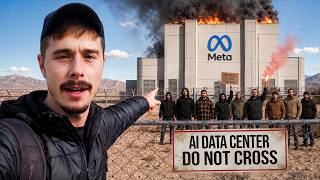
This debate contrasts the strategic necessity of expanding US data center infrastructure to maintain AI leadership against China with concerns regarding environmental impact, corporate power, and democratic erosion. The pro-expansion argument emphasizes national security, economic competitiveness, and the physical reality of AI compute needs, while the opposition highlights the disproportionate resource consumption, lack of tangible local jobs, and the anti-democratic intentions of tech elites.
Key takeaways 6
AI infrastructure is physical: AI requires massive compute power housed in physical servers within data centers, making it a foundational technology for national security and economic advantage, not just software.
Geopolitical competition: The US is in an AI race with China; failing to build sufficient domestic infrastructure risks ceding strategic advantages in military intelligence, cybersecurity, and manufacturing to a geopolitical rival.
Environmental trade-offs: Data centers consume significant water (1-3 million gallons/day for evaporative cooling) and energy; closed-loop systems reduce water use but increase electricity demand, shifting the environmental burden.
Corporate influence and secrecy: Tech leaders like Sam Altman, Peter Thiel, and Curtis Yarvin have expressed skepticism toward democracy and desire for technological over political governance, raising concerns about unchecked corporate power.
Job creation disparity: Data centers employ very few people (25-150 full-time employees) relative to their size and cost, unlike manufacturing or healthcare facilities which create broader economic benefits.
Regulatory challenges: Data center developers often use NDAs and trade secret clauses to obscure resource usage and impact from local communities and regulators, limiting transparency.
Notable quotes 5AI-generated: wording and quote attribution may be wrong. Use the play link to verify.
“AI is not just software floating in the cloud. It runs on physical chips inside physical servers and inside physical data centers.”
Alexander Maderas explains the tangible infrastructure required for AI, countering the abstract notion of 'the cloud'.
“If China, our biggest competitor in AI, wins the AI race, we aren't simply losing a software competition or a hackathon... We risk giving our primary geopolitical competitor an advantage in military intelligence, cyber security, robotics, manufacturing, scientific discovery, and economic productivity.”
▶ 6:07Alexander Maderas outlines the national security stakes of failing to build domestic data center infrastructure.
“Peter Thiel said, 'I no longer believe that freedom and democracy are compatible.' He also said that you could unilaterally change the world without having to constantly convince people through technological means. This is where I think technology is an incredible alternative to politics.”
Lee Horseradish cites Peter Thiel to argue that tech leaders have anti-democratic intentions and should not be trusted with critical infrastructure.
“These data centers have approximately 25 to 150 full-time employees even though it has a footprint the size of Manhattan. So they're not bringing in jobs like say a hospital or a factory...”
▶ 1:03:49Lee Horseradish argues that data centers do not provide significant local employment benefits compared to other infrastructure projects.
“Evaporative cooling systems use 1 to 3 million gallons a day. Closed loop plus dry coolers use below 10,000 gallons.”
▶ 1:00:59Moderator Dylan Ren provides specific water usage statistics to highlight the environmental impact of different cooling technologies.
Chapters & Sections (35)▼
0:05Data Centers and AI Infrastructurechapter3
3:06Data Centers as Computing Factories
4:31Data Centers as AI Infrastructure
6:28Benefits of US Data Center Expansion
8:05Arguments Against US Data Center Expansionchapter1
 7h 55m⏭ 2
 2h 7m⏭ 2
 1h 3m⏭ 3
 1h 11m⏭ 6
 1h 8m⏭ 4
 1h 11m⏭ 4
 1h 2m⏭ 4
 1h 5m⏭ 4
 1h 2m⏭ 3
 2h 13m⏭ 3
 1h 40m⏭ 2
 1h 40m⏭ 1
 34m⏭ 1
 3h 24m⏭ 3
 5h 6m⏭ 1
 2h 3m⏭ 1
 2h 31m
 1h 4m⏭ 1
 1h 18m⏭ 1
 2h 58m
 1h 6m⏭ 3
 1h 43m⏭ 4
 11h 54m
 1h 0m⏭ 1
 11h 54m⏭ 8
 33m
33m 6h 26m
 3h 54m⏭ 7
 9h 11m
 3h 59m⏭ 5
 46m
46m 54m⏭ 1
 54m⏭ 2