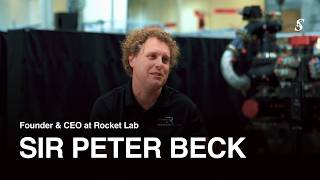
About this episodeRocket Lab demonstrates a strategy of aggressive asset acquisition, purchasing the bankrupt Virgin Orbit facil…AI summary
Rocket Lab demonstrates a strategy of aggressive asset acquisition, purchasing the bankrupt Virgin Orbit facility for $16 million to secure manufacturing capacity, while leveraging additive manufacturing to produce high-performance engines like the Rutherford and Archimedes. The company differentiates itself through vertical integration and a design philosophy focused on reusability and rapid turnaround, using methane for the Neutron rocket to avoid soot buildup and enable 24-hour turnarounds. The guest predicts the space industry is at a nascent stage of innovation, comparing current progress to the early days of the internet.
Key takeaways 7
Asset Acquisition Strategy: Rocket Lab purchased the former Virgin Orbit facility for $16 million, despite it containing over $100 million in assets, providing immediate access to a fully equipped engine development center.
Manufacturing Efficiency: The Electron production line produces one engine every 8 days, with over 930 engines having flown to space. The Archimedes production line also targets one engine every 8 days.
Additive Manufacturing Dominance: Most of the Rutherford and Archimedes engines are 3D printed, allowing for complex geometries and part consolidation. The facility uses laser powder bed fusion machines with up to 12 lasers, costing less than $10 million each.
Reusability Design Philosophy: Unlike expendable engines (Rutherford) which require only a 5-minute qualification burn, reusable engines (Archimedes) require a 1-hour qualification burn with 40 starts to ensure longevity and rapid reuse.
Fuel Choice for Reusability: Methane is chosen for the Neutron rocket's Archimedes engine over kerosene because it leaves no soot residue, enabling a 24-hour turnaround time between launches.
Industry Analysis: The guest notes that space companies are 'hard to kill' and often linger as 'zombie companies' due to enthusiast funding, making investor diligence difficult.
Neutron Configuration: The Neutron rocket uses 9 Archimedes engines on the first stage and 1 on the upper stage. This configuration is driven by physics, as the thrust of one upper-stage engine is ideal for landing the first stage.
Notable quotes 5AI-generated: wording and quote attribution may be wrong. Use the play link to verify.
“There was over $100 million worth of asset in that building and we managed to buy the whole thing for $16 million.”
Discussing the acquisition of the former Virgin Orbit facility.
“Space companies are really hard to kill. Like the amount of space companies that should be dead uh and not the sort of zombie companies is quite quite incredible.”
▶ 2:30Explaining why many struggling space companies continue to receive funding.
“The object of that engine was to make the most boring engine possible... You want to know that engine is boring, right? It's not going to blow up.”
▶ 20:23Describing the design philosophy for the Archimedes engine focused on reliability and reusability.
“I think the biggest thing to be done in space hasn't even been thought about let alone talked about... it's like we've sent our first email in the beginning of the internet.”
▶ 27:01The guest's 'hot take' on the future potential of the space industry.
“If you do the same [run a kerosene engine] there's just soot and black crap everywhere. So, it's just it's just not fun.”
Explaining why methane is preferred over kerosene for reusable rockets.
Chapters & Sections (16)▼
0:00Rocket Lab Engine Manufacturing and Facility Acquisitionchapter4
1:21Acquiring Virgin Orbit Assets
2:30Space Company Funding and Investor Diligence
3:52Rocket Lab Facility Tour and 3D Printing
5:153D Printed Engine Manufacturing Process
7:24Rocket Lab Engine Manufacturing and Designchapter2
9:25Large Scale Metal 3D Printing Technology
11:15Reusable vs Expendable Engine Design
13:06Electron Rocket Tour and Archimedes Engine Productionchapter4
15:04Electron Rocket Components and Vertical Integration
 40m⏭ 1
 49m⏭ 4
 45m⏭ 4
 35m⏭ 3
 56m⏭ 3
 59m⏭ 2
 24m⏭ 2
 38m⏭ 2
 46m⏭ 2
 3h 33m⏭ 2
 2h 18m
 17m⏭ 1
 41m⏭ 2
 2h 34m
 2h 17m⏭ 2
 3h 11m⏭ 2
 2h 51m⏭ 2
 3h 3m⏭ 3
 3h 59m⏭ 4
 32m
32m 1h 27m⏭ 2
 11h 23m⏭ 1
 33m
33m 1h 0m⏭ 1
 46m
46m 3h 54m⏭ 7
 3h 59m⏭ 5
 1h 13m
 54m⏭ 1
 58m⏭ 5
 25m
25m 45m⏭ 2
 1h 16m⏭ 2