About this episodeThe Nancy Grace Roman Space Telescope successfully launched on a Falcon Heavy rocket, ahead of schedule and un…AI summary
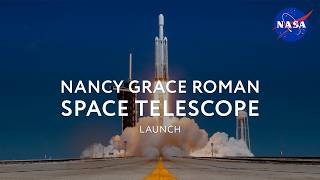
The Nancy Grace Roman Space Telescope successfully launched on a Falcon Heavy rocket, ahead of schedule and under budget, marking a major milestone for NASA's science mission. The mission aims to study dark matter, dark energy, and exoplanets using a field of view 100 times larger than Hubble, with first light expected before the winter holidays. The launch coincides with broader strategic initiatives including the Artemis 3 timeline, the creation of a new Space Academy, and future plans for on-orbit servicing and nuclear propulsion.
Key takeaways 8
Roman Telescope Specifications: The telescope has a field of view at least 100 times that of Hubble and a scan rate over 1,000 times faster, designed to discover up to 100,000 new exoplanets and map billions of galaxies.
Mission Status: The mission is proceeding ahead of schedule and on budget, with all initial deployments (solar panels, sunshade) nominal and telemetry syncing successfully.
Artemis 3 Timeline: NASA is targeting a summer 2027 launch for Artemis 3, with the wet dress rehearsal scheduled for the end of the year.
Space Academy Initiative: A new physical NASA-led Space Academy is being created to train engineers, astronauts, and leaders, modeled after the Merchant Marine Academy, to support a future of hundreds to thousands of annual launches.
On-Orbit Servicing Strategy: Roman includes a grapple fixture for potential future robotic servicing or refueling, building on lessons learned from the Swift mission attempt.
Synergistic Science: Roman is designed to work synergistically with other observatories like Hubble, James Webb, and Vera Rubin; it acts as a wide-field surveyor to find targets that Hubble and Webb can then study in detail.
Commissioning Plan: The commissioning period is planned for 90 days, with first images expected before the winter holidays. The first year will prioritize coronagraph technology demonstration and exoplanet observations.
Nuclear Propulsion Development: NASA is advancing nuclear power in space with SR1 Freedom (100kW converting to 25kW) and planning for more powerful systems (SR2-SR4) to enable missions to Uranus and Enceladus.
Notable quotes 5AI-generated: wording and quote attribution may be wrong. Use the play link to verify.
“Roman has a field of view at least 100 times that of Hubble, and over a thousand times the scan rate. So the telescope will provide a vast new atlas of the universe, potentially revealing more than 100,000 new exoplanets.”
▶ 4:19Jared Isaacman describing the scale and scientific capability of the Roman Telescope.
“We are not slowing down. We are continuing to accelerate America's grand return to the lunar surface... We are building the moon base... We're preparing dragonfly for its mission to Saturn's moon Titan in 2028.”
▶ 5:59Jared Isaacman outlining NASA's accelerated timeline for lunar and outer solar system missions.
“It's like sending your kids to college. They're going to have great adventures. But yeah, absolutely. There is that moment where you think, I'm never going to see that spacecraft again.”
Julie McHenry describing the emotional experience of watching the spacecraft depart for L2.
“We don't jump to the dream state, build up to it... You could either jump right to that [nuclear powered Mars missions], or you could start building up an a series of outer solar system science missions is risk reduction efforts.”
▶ 49:27Jared Isaacman explaining the strategic approach to developing nuclear propulsion technology through incremental missions.
“We're not competitors. We're stronger together... Roman is going to do what Roman does really well, which is to sweep out large regions of the sky. We still need Hubble to be doing what Hubble does really well.”
▶ 54:35Julie McHenry clarifying the collaborative relationship between Roman and other telescopes like Hubble.
Chapters & Sections (23)▼
1:30Nancy Grace Roman Telescope Launch and Mission Overviewchapter2
3:25Roman Telescope Post-Launch Status and Mission Goals
6:25Roman's Exoplanet and Life Search Goals
9:46Roman Telescope Science Goals and Launch Successchapter1
12:15Roman Telescope Launch Transition and Science Excitement
15:12Nancy Roman Tribute, Artemis 3 Timeline, and Space Academychapter1
17:40Space Academy Mission and Future
20:24Future Space Telescope Servicing and Lessons Learnedchapter1
22:09Roman Telescope Lessons Learned and Hubble Comparison
24:49Commissioning Timeline and Presidential Addresschapter1
27:38Emotional Launch Reflections and Presidential Remarks
29:57Roman Telescope Survey Planning and Launch Cadencechapter1
32:41Roman Survey Priorities and Launch Schedule
35:14Roman Telescope Budget Support and Scientific Goalschapter2
37:24Roman Telescope First Year Scientific Goals
38:52Roman Telescope Habitable Worlds Observatory Role
40:26Roman Coronagraph Tech and Lunar Base Planschapter1
43:26Mars Sample Return and Lunar Rover Plans
45:47Future NASA Flagship Missions and Astrobiologychapter4
48:08Rebuilding Core Competencies and Flagship Science
50:16Roman Telescope Exoplanet Survey and Collaboration
 50m
50m 9h 5m
9h 5m 1h 2m⏭ 2
 1h 0m
1h 0m 2h 38m
 8h 47m
 1h 50m
 54m
54m 50m⏭ 1
 3h 12m⏭ 5
 3h 26m⏭ 1
 3h 14m⏭ 3
 51m
51m 1h 23m
 4h 22m⏭ 4
 1h 42m
 3h 49m⏭ 4
 1h 30m⏭ 4
 1h 14m⏭ 3
 1h 0m⏭ 1
 11h 23m⏭ 1
 33m
33m 46m
46m 3h 54m⏭ 7
 3h 59m⏭ 5
 54m⏭ 1
 1h 13m
 58m⏭ 5
 25m
25m 45m⏭ 2
 1h 16m⏭ 2