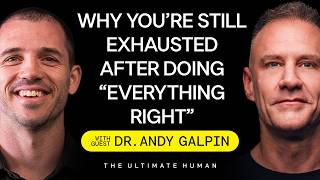
About this episodeDr. Andy Galpin discusses the critical importance of sleep quality, energy management, and physiological optim…AI summary
Dr. Andy Galpin discusses the critical importance of sleep quality, energy management, and physiological optimization, highlighting that sleep apnea is vastly underdiagnosed (70-80% of cases) and that wearable tech is best used for trends like resting heart rate rather than absolute sleep stage accuracy. He emphasizes that high performance relies on managing energy through stress inoculation and identifying hidden stressors, while advocating for a 'baker vs. cook' approach to fat loss based on personality types and the necessity of progressive overload in training.
Key takeaways 7
Sleep Apnea Prevalence: 70-80% of people with clinical sleep apnea go undiagnosed; for women, this rises to 90-95%. It is not limited to obese individuals and can be caused by neural, environmental, or positional factors.
Wearable Tech Limitations: Wearables are excellent for tracking total sleep time and trends (like resting heart rate correlating with sleep duration) but are poor at predicting specific stages like deep or REM sleep. The 'sleep quality score' is often misleading.
Light Exposure Impact: Morning light exposure sets the circadian rhythm and can mitigate the negative effects of evening light exposure. Urban environments have significantly higher noise (60-70 dB) and light pollution compared to rural areas (35 dB), impacting sleep resilience.
Melatonin Misuse: Melatonin is a circadian rhythm regulator, not a sedative. Taking it for sleep maintenance in the middle of the night is ineffective. Many supplements contain 100x the labeled dose, leading to next-day grogginess (sleep inertia).
Energy Management vs. Time Management: High performers excel at energy management by eliminating low-ROI activities (the '80/20 rule') and using 'stress inoculation'—practicing a skill to build endurance for that specific activity.
Fat Loss Personality Types: Galpin distinguishes between 'bakers' (need precise measurement and rules) and 'cooks' (can thrive on concepts and intuition). He recommends everyone start with the 'baker' approach for two weeks to calibrate their intuition before moving to concepts.
Exercise for Fat Loss: Exercise alone is insufficient for significant fat loss due to adaptive thermogenesis (the body compensating by burning fewer calories elsewhere), but it is crucial for maintaining weight loss long-term and improving metabolic health.
Notable quotes 5AI-generated: wording and quote attribution may be wrong. Use the play link to verify.
“70 to 80% of people who have clinical sleep apnea will go undiagnosed. And for women, it's somewhere in the neighborhood of 90 to 95%.”
▶ 0:50Dr. Galpin highlights the severe underdiagnosis of sleep apnea, particularly in women, who often attribute symptoms to hormones or stress rather than anatomical issues.
“There's no free passes in physiology. ... Caffeine can offset that [performance drop from sleep deprivation], but it doesn't actually put you back into the augmented spot. ... You will feel as good, but you will not perform as well.”
▶ 35:27Explaining the limits of stimulants; caffeine masks fatigue but does not restore cognitive or physical performance to rested levels.
“We are so wired to reward novelty. ... Scrolling on social media is kind of like the slot machine of variable rewards. ... The more unpredictable it is, the more likely you are to be like, 'One more, one more, one more.'”
▶ 44:48Explaining the psychological mechanism behind social media addiction and why it disrupts sleep via cognitive arousal rather than just blue light.
“The value is not in the data. The value is in the interpretation. ... If we had those theoretical data for you [diet impact on cholesterol], it's probably not healthy. ... But if it's presenting no risk to the place we actually care about [heart structure], then I'm less concerned.”
▶ 1:06:23Analyzing Stephen's blood work, emphasizing that raw numbers must be interpreted in context (family history, imaging results) rather than treated as absolute warnings.
“Atrophy leads to atrophy. ... The minute you do [accept aging as an excuse], you go on this downward cycle.”
▶ 1:24:07Discussing the importance of continuing physical activity to prevent the vicious cycle of pain avoidance leading to further physical decline.
Chapters & Sections (65)▼
0:00Sleep Science and Coaching Philosophychapter1
3:16Client Diversity and Physiological Approach
5:19Undiagnosed Sleep Apnea and Health Anxietychapter2
7:58Health Anxiety and Undiagnosed Sleep Apnea
9:34Sleep Apnea Misconceptions and Health Risks
11:05Sleep Apnea Causes, Prevalence, and Precision Treatmentchapter2
13:46Sleep Apnea Prevalence Statistics
14:59Sleep Diagnosis and Subjective Assessment
17:44Wearable Sleep Tech and Environmental Light Impactchapter3
20:19Resting Heart Rate and Sleep Duration
21:42Environmental Light Pollution and Sleep
23:13Mitigating Evening Light Exposure with Morning Sunlight
24:44Sleep Environment and Supplement Evidencechapter3
27:22Evidence-Based Sleep Supplements
28:37Sleep Supplement Evidence and Melatonin Risks
31:13Melatonin Dosage and Sleep Inertia
33:09Melatonin Mechanism and Caffeine Sleep Trade-offschapter1
35:03Caffeine Sleep Trade-offs and Ergonomics
38:15Screen Arousal and AI Retention Impact Sleepchapter1
41:13AI Personalization and Creator Competition
43:23Novelty, Variable Rewards, and Sleep Optimizationchapter2
45:02Variable Rewards and Dopamine Addiction
46:35Social Media Detox and Sleep Environment
49:08Optimizing Sleep Environment and Gender Differenceschapter2
51:15Gender Differences in Sleep Triggers
52:55Self-Experimenting for Sleep Optimization
54:20Sleep Resilience and Energy Managementchapter3
56:52Shopify Sponsorship and Mitochondria Energy
58:41Energy Management for High Performers
1:01:19Identifying Single Biggest Constraint
1:02:49Interpreting Blood Work and Cholesterol Riskschapter1
1:04:50Contextualizing Saturated Fat and Cholesterol
1:07:20Exercise Heart Remodeling and Cholesterol Managementchapter1
1:10:40Fiber and Stress Reduction for Cholesterol
1:12:19Integrating Lifestyle and Medicine for Healthchapter1
1:15:16Natural Living Paradox and Practical Grace
1:16:57Exercise, Mitochondria, and Stress Inoculation for Energychapter2
1:19:12SAID Principle and Redefining Exercise
1:20:41Stress Inoculation and Activity Adaptation
1:21:59Hidden Stressors, Atrophy, and Performance Spanchapter2
1:23:43Breaking the Atrophy Cycle Through Resistance
1:25:36Health Span vs Performance Span and Exercise Energy
1:28:19Grip Strength as Health Predictorchapter2
1:30:04Grip Strength Limitations and Asymmetry
1:32:42Measuring Grip Strength and Asymmetry
1:33:58Muscle Power, Powerpenia, and Rest Intervalschapter3
1:35:57Powerpenia and Training Frequency Myths
1:37:48Rest Intervals and Muscle Growth Evidence
1:39:08Prioritizing Rep Quality Over Rest
1:41:36Supplement Stacks and Fat Loss Baking vs Cookingchapter1
1:43:32Fat Loss: Baking vs Cooking Personalities
1:46:21Personality Types and Diet Detail Preferenceschapter1
1:47:36Measuring Food vs. Conceptual Eating
1:50:19Keto Awareness, Exercise Myths, and 54321 Methodchapter3
1:52:13Calorie Counting and Exercise Role in Fat Loss
1:53:4154321 Method and Training Plans
1:55:29Progressive Overload and AI Training Plans
1:57:34AI Fitness vs Human Connectionchapter3
1:59:13Why Information Alone Fails Behavior Change
2:01:04Proximity and Personal Loss Motivate Behavior
2:02:26Catalysts for Health Behavior Change
2:04:54Finding Purpose and Avoiding Bad Goalschapter3
 2h 48m⏭ 3
 1h 20m⏭ 3
 2h 11m⏭ 4
 2h 22m⏭ 4
 2h 31m⏭ 3
 2h 28m⏭ 2
 2h 11m⏭ 4
 1h 5m⏭ 3
 2h 1m⏭ 3
 1h 49m⏭ 2
 1h 52m⏭ 2
 3h 34m⏭ 2
 2h 22m⏭ 6
 3h 48m
 2h 27m⏭ 1
 2h 27m⏭ 8
 1h 23m
 1h 51m⏭ 5
 3h 41m
 2h 36m
 1h 37m⏭ 3
 1h 16m
 1h 39m⏭ 3
 1h 37m⏭ 4
 11h 23m⏭ 1
 33m
33m 3h 54m⏭ 7
 1h 0m⏭ 1
 46m
46m 48m⏭ 2
 3h 59m⏭ 5
 1h 13m
 54m⏭ 1
 25m
25m 45m⏭ 2
 1h 16m⏭ 2