About this episodeThis debate features Spencer Summerhazes arguing that war with Iran serves America's best interest through lon…AI summary
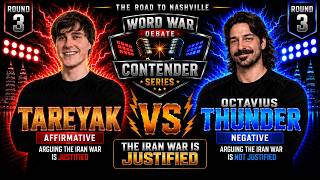
This debate features Spencer Summerhazes arguing that war with Iran serves America's best interest through long-term economic gains via Strait of Hormuz control, geopolitical leverage, and moral standing through regime change. Sylvio Cruz counters that the war is economically unsustainable due to asymmetric costs, destabilizes global order, and poses direct security threats to the US homeland through radicalization and retaliation.
Key takeaways 6
Spencer argues for 'long-term best interest' over short-term economic pain, citing tariffs and energy dominance as examples where immediate sacrifice yields future reward.
The Strait of Hormuz controls 20 million barrels of oil per day and 20% of global LNG trade; Spencer estimates a $10/barrel toll could generate $140 billion annually.
Sylvio highlights the asymmetric cost structure: Iran uses cheap drones/missiles while the US relies on expensive $1 billion radar systems, citing the destruction of a US radar in Qatar.
China is identified as a critical variable, providing Iran with advanced satellite feeds and man-portable air-defense systems, raising the risk of broader conflict.
Spencer defines the Iran war as starting on October 7th due to Iranian-backed proxy attacks, justifying preemptive action and regime change as necessary for moral standing.
Sylvio argues that US actions erode 'moral currency,' making it harder to form future alliances and potentially radicalizing Iranian-Americans or provoking homeland attacks by the IRGC.
Notable quotes 5AI-generated: wording and quote attribution may be wrong. Use the play link to verify.
“The US intelligence community continues to assess that Iran is not building a nuclear weapon.”
▶ 9:59Sylvio quotes former DNI Tulsi Gabbard to challenge the primary justification for the war.
“Short-term interest is selfish. Long-term interest improves the lives of your children and our nation to come.”
▶ 5:59Spencer defines his nationalist framework for evaluating America's best interests.
“We can't allow Iran impose the leverage on all of us and just be subject subject to their whims handcuffed by terrorists.”
▶ 46:09Spencer argues that controlling the Strait of Hormuz is essential to prevent enemy coercion.
“I think America's best interests, you know, uh involve being a country that's viewed as uh the defender of freedom abroad. You know, I think it's it's hard to say that we're the defender of freedom when uh anytime we we think something benefits us economically, we're going to go and change the regime until somebody gives us a deal that we like.”
▶ 54:09Sylvio critiques the moral inconsistency of using regime change primarily for economic gain.
“With great power comes great responsibility. With great authority comes great duty. A situation like the one in Iran is exactly the type of situation where you would need a dominant global military force to save the people from their own government when they simply cannot successfully revolt themselves.”
▶ 1:02:24Spencer justifies interventionism as a moral duty to protect citizens from tyrannical regimes.
Chapters & Sections (26)▼
0:06Iran War America's Best Interestchapter2
3:22Defining the Iran War and US Interests
5:06Long-Term National Interest Definition
6:40Iran War Geopolitics and Oil Strategychapter1
9:13Iran War Motivations and Economic Asymmetry
12:05Iran War Impact and Civilian Casualtieschapter
18:02Iran Nuclear Program and Regime Change Debatechapter2
21:21Iran Regime Change and Moral Justification for War
23:35Iran War Origins and Proxy Forces
26:40Strait of Hormuz Control and Israel Alliancechapter3
28:26Economic Impact of Strait of Hormuz Fees
30:17US Alliance With Israel In America's Best Interests
32:56Preemptive Strike Justification Against Iran
34:52Free Markets, Sovereignty, and Moral Currencychapter1
37:09Moral Currency and National Sovereignty
40:47China Iran Alliance US Military Responsechapter1
43:07Iran Satellite Intelligence and China Nuclear Threat
46:18Strait of Hormuz Toll Revenue Debatechapter3
49:02Maximum Viable Toll Economics
51:22Defining American Interests in Iran War
53:37US Treasury Revenue and International Law
56:27Iran War Economic and Moral Argumentschapter4
 7h 55m⏭ 2
 2h 7m⏭ 2
 1h 3m⏭ 3
 1h 11m⏭ 6
 1h 11m⏭ 4
 1h 5m⏭ 4
 1h 11m⏭ 4
 1h 2m⏭ 4
 1h 2m⏭ 3
 4h 5m⏭ 1
 4h 16m⏭ 4
 1h 28m⏭ 3
 23m
23m 3h 29m⏭ 4
 1h 43m
 2h 23m⏭ 4
 1h 33m⏭ 1
 29m⏭ 2
 3h 32m⏭ 2
 26m
26m 28m⏭ 1
 1h 43m⏭ 4
 1h 0m⏭ 1
 11h 54m
 11h 54m⏭ 8
 6h 26m
 33m
33m 3h 54m⏭ 7
 3h 59m⏭ 5
 9h 11m
 46m
46m 54m⏭ 1
 7h 50m