About this episodeBilly Carson and guest Filipo Beyond discuss SAR scan technology revealing a potential second Sphinx buried be…AI summary
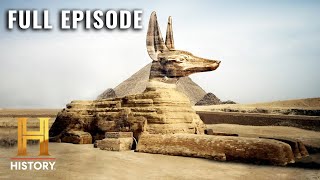
Billy Carson and guest Filipo Beyond discuss SAR scan technology revealing a potential second Sphinx buried beneath the sands of Giza, challenging mainstream Egyptology. The conversation explores ancient symbolism, the Emerald Tablets, and the possibility that Giza was designed as a dual guardian system with terrestrial and celestial counterparts.
Key takeaways 7
SAR (Synthetic Aperture Radar) technology uses 10 GHz energy beams from low earth orbit satellites to detect subsurface anomalies, solid spaces, and structural patterns beneath bedrock without excavation.
The Dream Stela located between the Sphinx's paws depicts two imaginary sphinxes facing each other, suggesting a dual guardian system rather than a single monument.
Billy Carson argues the Sphinx dates back 36,000-40,000 years based on water erosion patterns in the enclosure, contradicting the mainstream 4th Dynasty dating.
The Sphinx's face may have been recarved multiple times: originally Thoth (Atlantean), then Amun-Rah (Marduk), and potentially Marduk's son, explaining the disproportionate head size.
Ancient Egyptian architecture integrated astronomy, religion, and geometry; structures like pyramids and sphinxes were 'living symbols' and 'cosmic machines' using crystal granite to encode earth-sky relationships.
The constellation of Leo corresponds with the Sphinx's lion body, supporting the 'as above, so below' principle where terrestrial monuments mirror celestial bodies.
Filipo Beyond’s team discovered approximately 180 buried pyramids in the Sahara Desert using similar remote sensing technology, indicating widespread hidden structures.
Notable quotes 5AI-generated: wording and quote attribution may be wrong. Use the play link to verify.
“Synthetic aperture radar is not a shovel... It's an eye in the sky... sending what they call an energy beam 10 gigahertz down and it receives reflections back.”
▶ 3:56Explaining how SAR technology works to detect subsurface structures without physical digging.
“The Sphinx is the fusion of animal power and human awareness... It's the instinct and the intellect. It's the body rooted in nature and the face looking towards eternity.”
▶ 37:55Defining the symbolic meaning of the Sphinx's composite form.
“We're using space age technology to basically interrogate the stone and tell the stone, hey, give up your secrets.”
▶ 5:31Describing the purpose of using modern satellite tech on ancient sites.
“Every visible thing has an invisible counterpart in their mythos. Every earthly form has a heavenly reflection... Maybe we're searching for the missing half of a code.”
▶ 40:41Discussing the dualistic nature of Egyptian symbolism and the potential significance of a second Sphinx.
“The mainstream age of the Sphinx is way off... That would take us back to about 36 to 40,000 years ago.”
▶ 35:13Carson's controversial claim about the true age of the Sphinx based on erosion data.
Chapters & Sections (19)▼
0:03SAR Scan Technology Reveals Second Sphinxchapter2
2:08SAR Scan Second Sphinx Mystery
3:56SAR Technology vs Traditional Archaeology
7:16Sphinx Enclosure Access and Buried Structureschapter1
9:34Sphinx Enclosure Access and Underground Tunnels
12:25Sphinx Scan Evidence and Egypt Tripchapter1
16:09Sphinx Symbolism and Head Proportions
17:49SAR Scan Evidence of Second Sphinxchapter2
20:56Displaying SAR Scan Thumbnail
22:30Second Sphinx Scan Evidence and Excavation Plans
24:42Second Sphinx and Ancient Symbolismchapter2
26:55Sphinx as Celestial Lion and Horizon Guardian
30:31Ancient Worldview and Timeless Perspective
32:14Sphinx Erosion Dating and Symbolismchapter2
35:26Ancient Sphinx Dating and Erosion Evidence
37:24Sphinx Symbolism and Royal Theology
38:55Giza Duality and Second Sphinx Codechapter2
40:50Decoding Giza's Celestial and Terrestrial Code
 47m
47m 37m⏭ 2
 54m⏭ 1
 58m⏭ 5
 45m⏭ 2
 45m⏭ 2
 1h 14m⏭ 1
 54m⏭ 1
 58m⏭ 5
 54m⏭ 1
 28m
28m 1h 12m⏭ 2
 1h 58m⏭ 2
 2h 48m⏭ 2
 4h 26m
 42m
42m 1h 36m⏭ 1
 2h 56m⏭ 4
 2h 49m⏭ 2
 3h 25m⏭ 3
 2h 52m
 3h 22m⏭ 2
 2h 43m
 2h 55m
 11h 23m⏭ 1
 2h 35m
 1h 0m⏭ 1
 3h 54m⏭ 7
 33m
33m 3h 59m⏭ 5
 48m⏭ 2
 46m
46m 38m
38m 56m
56m 54m⏭ 2