About this episodeNASA successfully launched the Nancy Grace Roman Space Telescope aboard a SpaceX Falcon Heavy rocket, marking …AI summary
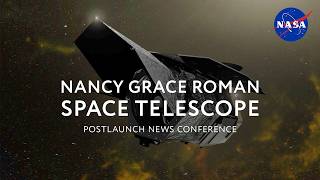
NASA successfully launched the Nancy Grace Roman Space Telescope aboard a SpaceX Falcon Heavy rocket, marking the beginning of a mission to map the universe's dark matter and dark energy while discovering up to 100,000 new exoplanets. The observatory, which operates with a field of view 100 times wider than Hubble's, will travel to the Sun-Earth L2 point to begin operations in early 2027, releasing petabytes of data to the public. This launch underscores the collaborative power of NASA and SpaceX, combining advanced infrared imaging technology with reliable heavy-lift launch capabilities.
Key takeaways 7
Roman Telescope Capabilities: The telescope features a field of view 100 times wider than Hubble's while maintaining similar sharpness, enabled by the largest infrared detector ever built (300 million pixels). Images will be massive, ranging from 1 billion to 1 trillion pixels, requiring 500,000 4K monitors to view a single large image at full resolution.
Dark Matter Visualization: Dark matter is invisible but exerts gravitational pull that distorts light from distant galaxies. Roman will map this by measuring these distortions (gravitational lensing), effectively creating a 3D map of the 'foam' of dark matter that makes up a significant portion of the universe's mass.
Exoplanet Discovery Goals: Roman aims to discover approximately 100,000 new exoplanets, including about 1,000 found via microlensing. This method allows detection of cold, rocky planets and those in habitable zones that are difficult to find with other methods.
Coronagraph Technology: The coronagraph instrument is designed to block starlight 10 million to 1 billion times more effectively than previous space-based coronagraphs. It uses deformable mirrors with ~2,000 pistons and single-photon counting detectors to isolate reflected light from planets, paving the way for future missions like the Habitable Worlds Observatory to search for signs of life.
Launch Vehicle Details: The Falcon Heavy rocket generated over 5 million pounds of thrust using 27 Merlin 1D engines. The side boosters performed boostback burns and landed simultaneously at Landing Zones 2 and 4 at Cape Canaveral Space Force Station.
Data Volume: Roman will generate approximately 1.5 terabytes of new imagery every day, equivalent to streaming a million songs daily from a million miles away.
Historical Context: Nancy Grace Roman, NASA's first chief astronomer, was instrumental in establishing the space telescope program, famously comparing ground-based astronomy to looking through stained glass windows.
Notable quotes 5AI-generated: wording and quote attribution may be wrong. Use the play link to verify.
“The most exciting science is going to be the thing that you didn't expect.”
▶ 2:20Dominic Benford on the potential for unexpected discoveries given Roman's unprecedented wide-field capabilities.
“She understood that the blurring introduced by the Earth's atmosphere was detrimental to astronomy. And if you could get out into space above the atmosphere, it would be so much better. She likened astronomers on the ground looking through the atmosphere, like looking at space through stained glass windows.”
▶ 12:10Megan Cruz explaining Nancy Grace Roman's pivotal role in advocating for space-based observatories.
“Roman combines Hubble's sharpness, but with 100 times the field of view.”
▶ 1:29:15Amy Choi describing the unique scientific advantage of Roman's Wide-field Instrument compared to existing telescopes.
“A planet like Jupiter is 10 million times fainter than the star that it's around. A planet like the earth is 1/10,000,000,000 as bright as the star. So you have to block that starlight exquisitely.”
▶ 1:35:19Dominic Benford explaining the extreme technical challenge addressed by Roman's coronagraph instrument.
“We're going to have this incredible movie... We don't even know yet. And that's the most exciting thing is to find out what we don't know.”
▶ 29:54Dr. Mike Henry describing the time-domain survey capability of Roman, which will capture changes in the universe over time.
Chapters & Sections (50)▼
1:20Nancy Grace Roman Telescope Launch Overviewchapter3
3:14Roman Telescope Dark Matter and Exoplanet Goals
4:42Nancy Grace Roman Legacy and Mission Goals
5:56Falcon Heavy Rocket Capabilities and History
8:04Nancy Grace Roman Legacy and Telescope Comparisonchapter2
11:23Nancy Grace Roman's Legacy and Hubble Comparison
13:12Roman Telescope Field of View
14:39Roman Telescope Launch Prep and Mission Goalschapter2
17:36Falcon Heavy Vehicle Configuration and Launch Sequence
19:17NASA's Ambitious Space Policy and Future Missions
21:00Falcon Heavy Fueling and Launch Prepchapter1
22:44SpaceX NASA Partnership and Mission Highlights
25:52Roman Telescope Instruments and Dark Energy Sciencechapter2
27:19Roman Telescope Dark Matter and Energy Science
30:25Launch Countdown and Collision Avoidance
31:49Roman Telescope Fueling and Integrationchapter1
34:28Roman Telescope Cleanroom Procedures
37:05Roman Telescope Design and Artemis 3 Updateschapter1
39:55Artemis 3 Rocket Assembly and Lunar Landers
42:01Roman Telescope Wide Field of View Technologychapter1
44:08Roman Telescope Detector Scale and Data Volume
46:23Roman Telescope Launch Prep and Science Goalschapter1
48:30Roman Telescope Launch Countdown and Science Goals
50:46Roman Coronagraph Technology and L2 Orbitchapter1
53:55L2 Orbit Benefits and First Light Timeline
55:47Nancy Grace Roman Legacy and Launch Countdownchapter1
59:13Falcon Heavy Final Countdown Procedures
1:01:42Falcon Heavy Final Launch Countdownchapter1
1:04:45Final Propellant Loading and Startup
1:06:41Falcon Heavy Launch and Stage Separationschapter2
1:08:55Falcon Heavy Booster Separation and Boostback Burns
1:10:40Falcon Heavy Stage Separation and Fairing Jettison
1:12:36Roman Telescope Launch and Booster Recoverychapter1
1:15:10Roman Telescope Orbit Insertion and Mission Timeline
1:18:18Roman Telescope Science Goals and Capabilitieschapter2
1:20:35Roman Telescope Forest Analogy
1:21:57Roman Telescope Galactic Surveys and Coronagraph Tech
1:23:39Roman Telescope Dark Matter and Exoplanet Researchchapter3
1:26:06Visualizing Dark Matter Distortion
1:27:15Wide-field Instrument Sky Mapping
1:29:12Roman Telescope Capabilities and Exoplanet Discovery
1:30:39Roman Telescope Launch and Coronagraph Technologychapter1
1:33:30Roman Coronagraph Technology and Future Missions
1:37:15Roman Telescope Deployment and Commissioningchapter2
1:40:44Post-Launch Deployment and Data Operations
1:42:06Engineering Checks and Science Commissioning
1:43:53Roman Telescope Refueling, Spectra, and Dark Energychapter3
1:45:39Dark Energy and Adopt a Pixel
1:47:10Nancy Grace Telescope Launch Conclusion and Status
1:48:38Roman Telescope Launch and Mission Overview
 50m
50m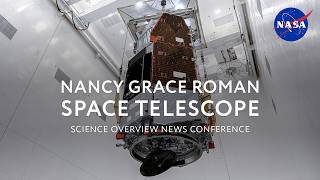 1h 2m⏭ 2
 56m
56m 9h 5m
9h 5m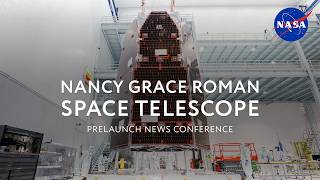 1h 0m
1h 0m 8h 47m
 2h 38m
 49m
49m 57m⏭ 2
 1h 23m
 1h 51m⏭ 1
 1h 28m⏭ 1
 54m
54m 3h 12m⏭ 5
 3h 26m⏭ 1
 3h 14m⏭ 3
 1h 37m⏭ 1
 2h 55m⏭ 2
 1h 57m
 2h 35m
 11h 23m⏭ 1
 1h 0m⏭ 1
 46m
46m 3h 54m⏭ 7
 33m
33m 3h 59m⏭ 5
 48m⏭ 2
 37m⏭ 2
 38m
38m 56m
56m 54m⏭ 2