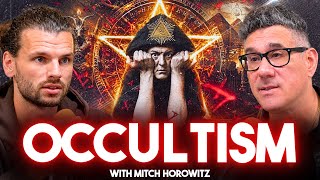
About this episodeMitch Horowitz explores the hidden occult and esoteric roots of mainstream Western culture, tracing influences…AI summary
Mitch Horowitz explores the hidden occult and esoteric roots of mainstream Western culture, tracing influences from Ronald Reagan and the US Dollar to Gandhi and the Founding Fathers. He argues for a rigorous, individualistic approach to spirituality that rejects conformity and embraces self-verification, drawing on Gnostic themes, simulation theory, and parapsychology to explain modern existential anxiety.
Key takeaways 8
Ronald Reagan’s speeches contained direct phrasing and narratives from Manley P. Hall’s occult book 'The Secret Destiny of America,' including the story of the 'Unknown Speaker' at the signing of the Declaration of Independence.
Gandhi’s philosophy of universal religious equality was ignited by his meeting with Madame Blavatsky in London, who taught him that all religions spring from a single esoteric source.
Freemasonry was a radical ecumenical force among Founding Fathers (Washington, Franklin, etc.) that introduced ideas of individual search for meaning and ethical development into colonial America, influencing the Constitution.
The Eye and Pyramid on the US Dollar bill was designed by a subcommittee chaired by Benjamin Franklin and placed on the bill by FDR and Henry Wallace (a Freemason and Theosophist) to symbolize that material sustenance requires inner knowing.
Daryl Bem’s research on precognition (retrocausality) shows statistically significant evidence that future actions can influence past cognitive performance, validated by meta-analyses across 33 nations.
The 'Barbie' movie resonated globally because it tapped into Gnostic themes of realizing one is living in an artificial reality under a false god, a sentiment transcending cultural boundaries.
Horowitz redefines Satanism not as evil, but as radical questioning, nonconformity, and the refusal to accept received notions without verification.
Neanderthals possessed spirituality, art, and talismans, suggesting that extraphysicality is an innate human trait rather than a cultural construct.
Notable quotes 5AI-generated: wording and quote attribution may be wrong. Use the play link to verify.
“Rationalism is not conclusion. It's process. Rationalism is methodological replication.”
▶ 6:55Horowitz explaining why Freud, often seen as a rationalist, was deeply interested in occult topics like telepathy and clairvoyance.
“We talk to dilute them. We talk to disperse. We're silent to concentrate, to focus.”
Horowitz explaining the occult principle of silence as a way to maintain the power of a wish or intention.
“I am not hopeful about humanity. I am not a lover of humanity. I am a lover of individual people very few in number.”
▶ 1:24:55Horowitz expressing his skepticism about collective human progress while emphasizing faith in individual agency.
“The mask is conformity... That's not wearing a mask. That's dropping a mask.”
▶ 1:26:20Horowitz discussing his leather jacket persona and referencing Peter Criss of KISS, arguing that authentic self-expression is revealing, not hiding.
“Don't come to horror what's for forgiveness... I counsel abiding versus forgiving.”
▶ 2:34:31Horowitz challenging the spiritual rule of mandatory forgiveness, suggesting that enduring trauma without forgiving can be refining.
Chapters & Sections (74)▼
0:00Occult Roots in Abrahamic Traditionschapter3
1:41Jim Henson's Mythical and Esoteric Work
3:19Ancient Astrology and Occult History
4:54Freud's Occult Interests and Erased History
9:02Verifying Historical Truth and Translationschapter1
12:07Skepticism in Historical and Spiritual Verification
14:18Astrology's Ancient Roots and Enduring Popularitychapter2
16:00Astrology's Ancient Roots and Accuracy
17:54Astrology Popularity and Grandfather's Skepticism
19:23Gnostic Reality and Apocalyptic Anxietychapter1
22:32Barbie's Gnostic Themes and Global Resonance
24:37Simulation Theory and Gnostic Brokennesschapter1
26:34Gnostic Brokenness and Financial Skepticism
29:35Apocalyptic Escapism and Spiritual Orthodoxychapter2
31:48Rabbi's Toupee Scandal and Subculture Boundaries
33:47Rejecting Spiritual Orthodoxy and Embracing Flexibility
35:59Trauma, Spiritual Beliefs, and Self-Observationchapter1
40:58Lying, Self-Observation, and Human Automata
43:49Self-Help Label and Dad's Political Campaignchapter1
47:12Firing from Free Press Publishing
49:30Career setbacks and spiritual rediscoverychapter2
52:19Male Testosterone Decline and Supplement Solution
53:56Rediscovering Esoteric Interests in Publishing
56:16Neville Goddard's Influence on Writing and Lifechapter2
58:39Neville Goddard's Imagination Philosophy
1:01:37Publishing Challenges and Accountability
1:04:21Reagan's Use of Manly P. Hall's Occult Ideaschapter1
1:08:12Reagan's Use of Manly P. Hall's Occult Ideas
1:11:29Napoleon Hill's Think and Grow Rich and Wallace Wattleschapter1
1:14:52Wallace Wattles Socialist Views
1:16:32Wallace Wattles, Book Titles, and Do Lesschapter2
1:19:23Monroe Institute Do Less Guidance
1:20:35Health Crisis and Applying Do Less
1:22:11Silence, Transparency, and Authentic Personachapter3
1:23:49Crisis of Transparency in Spiritual Communication
1:25:24Authenticity vs Conformity and Persona
1:27:28Authenticity Through Self-Revelation
1:29:08Authentic Wishes and Privacychapter2
1:31:52Overcoming Habit to Speak Truth to Self
1:33:29Flexibility in Accepting Unexpected Gifts
1:35:34Chaos Magic, Hypnagogia, and Silencechapter1
1:39:20Harnessing Hypnagogia and Silence for Manifestation
1:41:09Reclaiming Esoteric Terms and Ancient Spiritualitychapter2
1:43:24Stripping Conformity to Recover Ancient Spiritual Fragments
1:45:09Catholicism as Vessel of Universal Religion
1:47:30Redefining Satanism and Left-Hand Path Spiritualitychapter3
1:49:12Metaphysical Satanism and Radical Questioning
1:50:43Consequences of Unconventional Spiritual Views
1:52:55Human Nature and Left-Hand Path Ethics
1:55:04Tradition Calcification and Intellectual Standardschapter2
1:57:03Personal Growth and Paul Kranner
1:58:25Applying Standards to Controversial Themes
2:00:25Financial Advice and Lenin's Self-Developmentchapter5
2:01:49S&P 500 Investment Strategy and Lenin
2:03:28Tsarist Russia's Educational Paradox
2:05:22Gandhi, Hitler, and the Occult
2:06:55Gandhi's Encounter with Theosophy
2:09:16Gandhi's Theosophical Influences
2:11:54Madame Blavatsky's Global Spiritual Influencechapter1
2:13:51Blavatsky's Role in Introducing Eastern Occultism
2:17:08Freemasonry's Influence on American Foundingchapter1
2:19:06Occult Symbols on the Dollar Bill
2:22:22Occult Symbols and Precognition Researchchapter1
2:24:44Cognitive Retrocausality and Skepticism
2:27:38Parapsychology Research and Retrocausalitychapter2
2:29:57Manifestation and Retrocausality in Sports
2:31:08Retrocausality in Combat Sports
2:32:55Questioning Forgiveness as Spiritual Imperativechapter1
2:35:43Spiritual Rules and Religious Artifice
2:38:07Navigating Suffering, Anger, and Individual Hopechapter1
2:40:41Embracing Joy, Anger, and Individual Ethics
2:43:35Occult Influences on Gandhi and Reaganchapter2
 3h 13m
 3h 28m
 2h 20m
 3h 17m
 37m⏭ 4
 3h 43m⏭ 2
 36m⏭ 4


 2h 58m⏭ 6
 3h 21m⏭ 3
 1h 27m⏭ 4
 1h 32m⏭ 2
 48m
48m 2h 15m⏭ 3
 3h 57m⏭ 3
 2h 33m⏭ 2
 2h 34m⏭ 4
 2h 49m⏭ 2
 2h 57m⏭ 2
 1h 21m
 2h 35m
 11h 23m⏭ 1
 1h 0m⏭ 1
 46m
46m 3h 54m⏭ 7
 33m
33m 3h 59m⏭ 5
 48m⏭ 2
 37m⏭ 2
 38m
38m 56m
56m 54m⏭ 2