About this episodeDavid Friedberg argues that the US is facing an inevitable slide toward socialism due to unaffordability, nati…AI summary
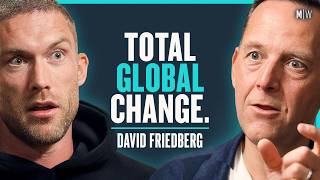
David Friedberg argues that the US is facing an inevitable slide toward socialism due to unaffordability, national debt, and government overreach, which stifles the transition of individuals from labor to capital. He advocates for free-market solutions like ending federal student loans, opposing wealth taxes, and embracing open-source AI to drive innovation and job creation rather than displacement.
Key takeaways 7
The American Dream is defined as transitioning from labor (paycheck-to-paycheck) to capital (asset ownership generating passive income); socialism prevents this by keeping everyone in labor.
Government intervention in markets like higher education increases costs; the federal student loan program allowed tuition to rise because there was no market constraint on pricing.
AI will not cause mass unemployment; historical data shows technology increases productivity, expands the economic pie, and creates new roles, though it shifts the skill requirements upward.
Wealth taxes are asset seizures that violate private property rights and are unconstitutional; effective tax policy should focus on taxing transactions (capital gains/income) rather than holding assets.
Open-source AI models democratize access to technology, preventing monopolies by a few tech giants and enabling new entrepreneurs to build valuable companies from zero net worth.
The US national debt is unsustainable without inflation or socialism; the Federal Reserve printing money to buy debt devalues the dollar, forcing a political shift toward wealth redistribution.
Housing is often a poor investment for wealth building due to high costs and lack of liquidity; investing in the S&P 500 historically offers better returns with fewer burdens than homeownership.
Notable quotes 5AI-generated: wording and quote attribution may be wrong. Use the play link to verify.
“The key measure of a country's success is how many people are transitioning from labor to capital each year.”
▶ 12:59Friedberg defines the core economic goal for individuals and the nation as moving from wage dependence to asset ownership.
“Wealth taxes are asset seizures.”
▶ 18:59Friedberg argues against wealth taxes, stating they violate the founding principle of private property rights and are legally problematic.
“In the next 10 years, there will be a billionaire that will emerge that has zero net worth today, downloaded open sourced AI, and built a company that made them a billionaire.”
▶ 0:36Predicting that open-source AI will lower barriers to entry, allowing new entrepreneurs to create massive value without initial capital.
“The great lie is that the government will save you. But the more government has tried to create services for people... the more expensive those things get.”
▶ 1:47:58Explaining how government subsidies in education and healthcare have driven up costs rather than improving affordability.
“Aging is the core human disease... epigenetic reprogramming... can move the switches just back to their right position.”
▶ 1:39:19Friedberg explains the biological mechanism of aging and how new therapies aim to reverse it by resetting epigenetic markers.
Chapters & Sections (53)▼
0:00US Empire Decline, AI Revolution, and Career Pathchapter1
2:14Career Path and Professional Journey
5:27PCAST Role and AI Policy Debateschapter1
7:29US Economic Crisis and AI Policy
10:33Government Intervention, Socialism, and Labor to Capitalchapter1
13:08Transitioning From Labor To Capital
16:16National Debt, Socialism, and Private Property Rightschapter2
17:50Capital Compounding vs Labor Taxation
19:06Private Property Rights and Taxation
23:21Wealth Tax Risks and Housing Market Critiquechapter1
25:07Critique of Homeownership as Wealth Strategy
29:02Human Agency vs Government Controlchapter1
31:17Government Barriers vs Individual Agency
33:59Government Safety Nets, Personal Agency, and Inequalitychapter1
36:39Education Agency and Inequality Dynamics
39:08Political Incentives and Term Limitschapter1
42:05Government Ethics and Innovation Incentives
44:24US Progress vs Denmark Happiness Trade-offchapter1
46:50UK Millionaires Leaving Due to High Taxes
49:19AI Job Loss Myths and Economic Growthchapter1
51:50Historical Tech Job Loss Myths
54:40AI's Impact on Creativity and Human Workchapter2
57:20AI Augments Human Creativity and Agency
58:47Rise of the Live Experience Economy
1:00:22AI Revenue Growth and Job Creationchapter1
1:02:42Human Adaptability and AI Potential
1:05:40AI Job Cuts and Incentive Trustchapter2
1:07:48AI Customer Service Cuts and Trust
1:09:21AI Productivity and Job Growth
1:12:23US AI Policy and Economic Impactchapter1
1:14:33AI Job Creation and Policy Triggers
1:16:56AI Impact on Jobs and Open Sourcechapter1
1:19:24Open Source AI Benefits and Risks
1:22:00AI Inequality, Productivity, and Labor Choicechapter2
1:24:13Historical Decline in Work Hours
1:25:41Market Adaptation: Uber and Medallion Crisis
1:27:16AI Impact, Socialism, and Wealth Taxchapter3
1:29:09Socialism, UBI, and Loss of Liberty
1:30:38Private Property Rights vs Wealth Tax
1:31:59Wealth Tax Ineffectiveness and Tax Reform
1:34:30Federal Spending and Epigenetic Aging Mechanismschapter1
1:37:55DNA Damage and Epigenetic Aging
1:40:03Epigenetic Reprogramming and AI in Agingchapter1
1:43:13AI Accelerating Biological Discovery and Job Creation
1:46:13American Great Lies and US Foreign Policychapter1
1:48:10US Healthcare and China Foreign Policy
1:51:10US-Iran Stalemate and 2028 Election Predictionschapter1
1:53:58Iran Leverage and 2028 Election Predictions
1:56:20AI Abundance, Open Source, and Student Loanschapter4
 2h 48m⏭ 3
 1h 20m⏭ 3
 2h 11m⏭ 4
 2h 22m⏭ 4
 2h 31m⏭ 3
 2h 28m⏭ 2
 2h 11m⏭ 4
 1h 5m⏭ 3
 2h 1m⏭ 3
 1h 49m⏭ 2
 1h 52m⏭ 2
 3h 34m⏭ 2
 1h 18m
 1h 14m⏭ 5
 1h 16m
 6h 42m
 36m
36m 1h 40m
 1h 12m⏭ 3
 1h 38m⏭ 2
 2h 50m⏭ 5
 1h 31m
 1h 4m
1h 4m 52m
52m 11h 23m⏭ 1
 33m
33m 1h 0m⏭ 1
 46m
46m 48m⏭ 2
 3h 54m⏭ 7
 3h 59m⏭ 5
 1h 13m
 38m
38m 1h 16m
 54m⏭ 2
 10h 34m