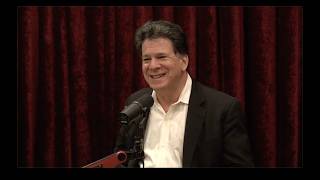
About this episodeEric Weinstein argues that American science has stagnated since the mid-1960s due to the imposition of bureauc…AI summary
Eric Weinstein argues that American science has stagnated since the mid-1960s due to the imposition of bureaucratic controls, peer review, and HR-driven conformity, which have created a 'scientific proletariat' unable to take high-risk bets. He contends that fundamental physics has stalled because the field abandoned practical applications for safe, abstract theories, potentially hiding revolutionary technologies like gravity shielding or dark chemistry. He advocates for a return to individualistic, high-agency funding models that back people rather than ideas, and urges scientists to engage with political leaders to reform the system.
Key takeaways 7
Historical Shift: Science funding and control changed drastically between 1965 and 1975, specifically with the Mansfield Amendment (1969-1971) which restricted military funding for blue-sky research, forcing scientists to rely on government grants with peer review, leading to risk aversion.
Peer Review Origins: Peer review was not a traditional scientific practice but was introduced in the 1960s by doctors resisting government oversight of Medicare payments, later adopted by the NSF in 1975 during political controversies.
Physics Stagnation: Theoretical physics effectively stalled in 1983-1984 when leaders like Edward Witten, David Gross, and Leonard Susskind shifted the field away from physical world applications (like nuclear weapons tech) toward abstract string theory, which has produced no new physical knowledge in 42 years.
Market Failure in Science: Pure science is an 'inexhaustible and inexcludable' good that markets cannot price correctly; therefore, government funding is essential, but current ROI on government research has declined 80-fold.
Funding Model: The current grant system favors low-beta (predictable) outcomes. Weinstein proposes a 'slush fund' model where top-tier scientists are retained on retainer to solve specific national problems, similar to how venture capitalists back founders (like Slack's Stewart Butterfield) rather than just ideas.
Secret Research: Weinstein suggests that advanced physics research may be happening in secret at places like Renaissance Technologies or Brookhaven National Lab, analogous to the Manhattan Project's reference committee which suppressed non-secret research on chain reactions.
UAPs and Propulsion: UAPs may be nation-state experimental weapons systems resulting from breakthroughs in gravity shielding or anti-gravity research from the 1960s/70s. He believes 'pinch-to-zoom' or 'shear-to-tilt' multi-touch gestures in spacetime geometry could enable faster-than-light travel.
Notable quotes 5AI-generated: wording and quote attribution may be wrong. Use the play link to verify.
“We have become a nation when it comes to science.”
▶ 0:00Weinstein describing the loss of intellectual diversity and the pressure for consensus in American scientific institutions.
“The stagnation in physics may have led to the survival of the human species.”
▶ 0:06Weinstein suggesting that if physics had continued advancing at the pace of the Manhattan Project, humanity might have developed weapons too destructive to exist.
“When we make this jump, the world will become unrecognizable.”
▶ 0:13Weinstein referring to the potential breakthroughs in physics (like SU4 gauge theory) that could unlock new forms of energy and propulsion.
“I want to blow a giant hole in the Civil Rights Act so that we can have teams that are not constantly afraid of HR.”
▶ 21:30Weinstein's provocative proposal to remove HR interference from scientific teams to allow for high-agency, individualistic collaboration.
“You've created the American scientific proletariat.”
▶ 10:43Weinstein arguing that the current system prevents professors from going against consensus because they cannot afford to lose their jobs or funding.
Chapters & Sections (38)▼
0:00Stagnation and Freedom in American Sciencechapter2
2:55American Science Stagnation and Freedom
5:16Scientific Consensus and the Scientific Proletariat
7:19Science, Covert Ops, and Academic Conformitychapter2
8:58Journalism, Science, and Political Narratives
10:30Academic Conformity and Free Speech
12:261960s Shift in Science Funding and Controlchapter2
15:02MIT Physics Protest and Government Distrust
16:39Science Funding Shift and Intellectual Conformity
20:49Critiquing HR, Civil Rights, and Peer Reviewchapter1
23:37Hyperindividualism and Peer Review Origins
25:43Market Failure and Public Funding for Sciencechapter1
29:06Market Capital and Research Funding
31:09Science Funding and Scientific Mindsetchapter1
34:46Scientific Legacy vs Silicon Valley Wealth
36:32Science Funding: Portfolio Theory and Backing Peoplechapter1
39:32Shorting Geometric Unity and Scientific Blockers
41:46Physics Field Crisis and Secret Researchchapter2
44:041983 Physics Shift and Secret Research
45:56Historical Reference Committee and Modern Analogies
49:09Physics Stagnation and Secrecy Claimschapter1
51:58Physics Stagnation and AI Progress
54:15Grand Unification and Neutrino Transmutationchapter2
56:36Neutrino Properties and Earth Penetration
57:47Neutron Beta Decay and Neutrino Discovery
59:26Physics Stagnation and Scientific Leverage Riskschapter1
1:02:43Accessibility of Nuclear Weapons and Physics Risks
1:05:26Nuclear Proliferation, UAPs, and Multi-Temporal Threatschapter1
1:07:44Multi-Temporal Adversaries and Solar System Escape
1:10:17Critique of General Relativity and Dark Energychapter1
1:12:48General Relativity Flaws and Pinch to Zoom
1:16:01AI, China, and Physics Paradigm Shiftschapter1
1:17:56AI Accessing Rejected Physics Theories
1:21:23UAPs, Gravity Shielding, and Nuclear Significancechapter4
1:22:53UAPs as State Weapons and Research Risks
1:24:40Gravity Shielding and Interstellar Travel
1:26:29Nuclear Significance and Advanced Propulsion
1:28:14Extraterrestrial Contact and US Scientific Leadership
 1h 23m
 1h 33m⏭ 1
 1h 4m
1h 4m 28m
28m 1h 18m⏭ 1
 27m
27m 1h 43m⏭ 1
 1h 27m
 1h 31m
 1h 9m⏭ 2
 1h 10m
 50m
50m 1h 18m⏭ 2
 2h 53m⏭ 2
 2h 29m⏭ 3
 1h 48m⏭ 3
 3h 58m⏭ 2
 3h 29m⏭ 4
 46m
46m 4h 3m
4h 3m 4h 6m
4h 6m 1h 17m
 45m
45m 1h 14m⏭ 1
 3h 17m
 1h 28m⏭ 1
 53m
53m 1h 28m⏭ 2
 2h 50m⏭ 3
 2h 16m⏭ 2
 2h 46m
 11h 23m⏭ 1
 33m
33m 1h 0m⏭ 1
 46m
46m 3h 54m⏭ 7
 48m⏭ 2
 3h 59m⏭ 5
 1h 13m
 38m
38m 54m⏭ 2
 54m⏭ 1
 58m⏭ 5