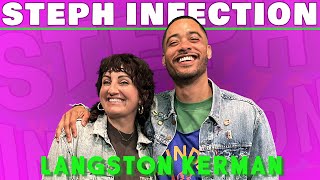
About this episodeLangston Kerman discusses his journey from childhood basketball and poetry to standup comedy, highlighting how…AI summary
Langston Kerman discusses his journey from childhood basketball and poetry to standup comedy, highlighting how his Master's in Poetry taught him concise writing and how teaching 14-year-olds built his crowd work resilience. He emphasizes the importance of balancing individual ambition with team success in both acting and comedy, noting that acknowledging heroes who recognize your existence is a key motivator.
Key takeaways 5
Teaching 14-year-olds is the most difficult form of crowd work because students are mean and unfiltered, which trains comedians to handle hostile audiences and maintain control.
Standup comedy is described as a 'sickness' rather than just a skill; the drive to perform badly and return repeatedly indicates a compulsion that fuels growth.
Writing for TV/film requires shifting responsibility from self-expression to serving the ensemble and the overall story, whereas standup is a solitary partnership with the audience.
The presence of heroes acknowledging your existence (like KG or Ray Allen in basketball) provides a unique motivational boost that validates potential and drives performance.
A Master's in Poetry helps comedians write concisely by forcing them to prioritize personal stories and strip away unnecessary words, improving script efficiency.
Notable quotes 4AI-generated: wording and quote attribution may be wrong. Use the play link to verify.
“There's no harder form of crowd work than talking to 14 year olds... the meanest things that have ever been said to me came from little nasty unwashed people.”
▶ 0:00Kerman explains how his teaching experience prepared him for the unpredictability and hostility of live comedy audiences.
“I've long equated stand up to more of a sickness than I think it is like a skill set... there's something wrong with your brain if you go and do bad and then you go I want to go do bad again.”
▶ 14:51Kerman describes the addictive nature of performing, even when bombing, which distinguishes true comedians from those who quit after failure.
“I want everybody to know I exist and be like 'he can do it'... that's the thing that has kept me sort of like driven in all of these Arts.”
▶ 41:43Kerman shares that validation from legends he admired (like Kobe Bryant or Ray Allen) was a primary driver for his success in both sports and entertainment.
“My responsibility isn't to one character... my responsibility is to the whole story that's building in front of us... you got to make sure that everybody's getting their just doe.”
▶ 27:11Kerman contrasts the self-centered nature of standup with the collaborative responsibility required in ensemble acting and writing.
Chapters & Sections (43)▼
0:00Childhood Bullying and School Experienceschapter3
0:00Childhood Bullying and School Experiences
1:50Preserving Architectural History vs. Personalization
4:00Childhood Sports Memories and Team Dynamics
5:24Childhood Fights and Personal Growthchapter4
5:24Overcoming Childhood Anger and Aggression
6:55Childhood Memories and Personal Growth
8:35Navigating Education and Career Path Choices
10:05Overcoming Performance Pressure and Crowd Distractions
12:34Discovery of Standup Comedy Career Pathchapter2
12:34Finding Humor in Adversity and Self-Discovery
14:03The Origins of Stand-up Comedy Career
16:47Balancing Individual Ambition with Teamworkchapter3
16:47Finding Success in Teamwork and Collaboration
18:15Balancing Individual Ambition with Team Success
19:46Early Influences on Comedy Career Development
22:22Overcoming Adversity through Resilience and Educationchapter2
22:22Overcoming Adversity through Resilience and Education
24:55Balancing Multiple Creative Pursuits in Entertainment
26:47Writing for Film and TV vs Stand-up Comedychapter3
26:47Writing for Film and TV vs Stand-up Comedy
28:38Managing Hecklers in Standup Comedy
29:58Managing Conflict and Maintaining Audience Engagement
31:42Challenges of Acting in Comedy-Drama Roleschapter3
31:42Challenges of Acting in Comedy and Drama
33:13Acting Experience in a TV Comedy Series
34:40Acting Career Growth and Mentorship
36:41The Art of Immersion in Actingchapter1
36:41Acting and Immersion in Film Scenes
40:57Overcoming Self-Doubt and Finding Confidence in Artchapter3
40:57Importance of Recognition in Creative Pursuits
42:33Collaboration and Unexpected Career Opportunities
44:04Overcoming Idolization and Finding Peer Relationships
47:07Meeting and Observing Basketball Legendschapter2
47:07Meeting and Observing Basketball Legends
49:24Memory and Cognitive Abilities Discussion
51:27Jason Simpson as Prime Suspect in Nicole Brown Murderchapter3
51:27OJ Simpson Murder Conspiracy Theory Discussion
53:18OJ Simpson's Possible Involvement in the Bronco Chase
54:47Debunking Celebrity Conspiracy Theories and Rumors
56:13The Evolution of Social Media and Realitychapter2
 28m
28m 28m
28m 21m
21m 25m
25m 14m
14m 19m
19m 1h 18m
 52m
52m 24m
24m 16m
16m 29m
29m 44m
44m
 4h 5m⏭ 4
 2h 20m
 2h 10m
 1h 10m
 2h 30m⏭ 3
 2h 3m⏭ 1
 1h 20m
 2h 35m⏭ 2
 1h 0m
1h 0m 32m
32m 40m
40m 1h 10m
 1h 0m⏭ 1
 33m
33m 46m
46m 3h 54m⏭ 7
 3h 59m⏭ 5
 54m⏭ 1
 1h 13m
 54m⏭ 2
 58m⏭ 5
 45m⏭ 2
 1h 16m⏭ 2
 1h 26m