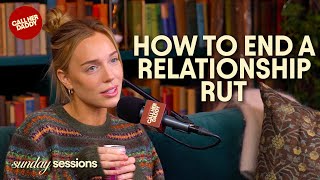
About this episodeThe conversation explores how romantic relationships and business serve as mirrors for inner insecurities, par…AI summary
The conversation explores how romantic relationships and business serve as mirrors for inner insecurities, particularly the fear of not being enough. It emphasizes that lasting love requires moving beyond initial lust and euphoria through mindfulness, accountability, and honest communication, rather than seeking a partner to fix or fulfill one's emotional voids.
Key takeaways 8
The root of relationship drama is often the universal fear of 'not being enough,' which causes individuals to act out, cling, or shut down due to insecurity rather than the partner's actual behavior.
Business and romantic relationships are unique environments that expose inner patterns because they involve high stakes, self-worth attachment, and significant time investment, unlike casual interactions.
McNamara's Fallacy applies to relationships: we care about what we can measure (money, followers) rather than what we should care about (relationship satisfaction), because the latter lacks easy metrics.
The mind is a 'battlefield' of story-making; unexamined thoughts and assigned meanings (e.g., 'if he loved me, he would...') create conflict and isolation within the relationship.
Lust is often mistaken for love in the first 3-9 months; it is a euphoric state driven by novelty and chemistry, whereas mature love is an intentional practice that accepts flaws and chooses the partner despite them.
Women primarily seek safety and presence from male partners, not problem-solving; men often mistakenly try to 'fix' emotional distress, which can make partners feel unheard or scared by their emotions.
You cannot convince someone to love you, nor can you will yourself to love someone who isn't right for you; desire happens bottom-up, not top-down.
Making peace with parents involves reframing the narrative about them, grieving the parent you didn't have, and recognizing their humanity, which can release the 'chokehold' of childhood conditioning on adult relationships.
Notable quotes 5AI-generated: wording and quote attribution may be wrong. Use the play link to verify.
“Unspoken expectations are premeditated resentments.”
▶ 18:59Neil Strauss quote cited by the guest to highlight how hidden expectations destroy relationships.
“We intend to measure what we care about but instead we end up caring about what we can measure.”
▶ 9:59Explanation of McNamara's Fallacy applied to why people focus on tangible success metrics over relationship health.
“Immature love says I am in love with my projected idealization of you and the moment you show me that you're real I going to pull away and mature love says I see all of you... and I choose you.”
▶ 35:11Defining the difference between infatuation-based love and committed, mature love.
“No one is coming to save you. A relationship is meant to make us happier not happy.”
▶ 1:13:55Addressing the misconception that a partner will fulfill all emotional needs or rescue one from misery.
“It's not about being stoic... vulnerability gets you far. Why? Because people bond when they open up their hearts to each other... if you're always hiding behind the mask of stoicism then it's just a wall.”
▶ 46:51Explaining why emotional availability and vulnerability are critical for building trust.
Chapters & Sections (60)▼
0:00Overcoming Relationship Insecurities and Fearchapter2
0:00Overcoming Relationship Insecurities and Fears
2:07Self-Reflection in Relationships is Key
5:48Business and Relationships Expose Inner Patternschapter2
5:48Business and Relationships Expose Inner Patterns
8:02Importance of Intimate Relationships Over Success
10:20Importance of Measuring Relationship Satisfactionchapter3
10:20Importance of Measuring Relationship Satisfaction
12:06Relationship Challenges and Communication Skills
13:30Relationships and the Human Mind
16:12Managing Relationships and Mindful Storytellingchapter2
16:12Managing Relationships and Mindful Storytelling
18:42Managing Expectations in Relationships
20:31Accountability in Relationships is Keychapter2
20:31Accountability in Relationships
23:05Importance of Choosing Right Relationship Partner
25:18Managing Fear in Relationshipschapter4
25:18Overcoming Relationship Fears and Anxiety
26:59Transitioning from Reactive to Responsive State
28:27Overcoming Boredom and Understanding Love
30:35The Difference Between Chemistry and Love
33:17Recognizing Immature Love Patterns in Relationshipschapter3
33:17Recognizing Immature Love Patterns in Relationships
35:41Managing Relationship Altitude Change
36:58Transition from Honeymoon to Committed Stage
38:11Maintaining Trust and Respect in Relationshipschapter3
38:11Maintaining Trust and Respect in Relationships
39:35Importance of Self-Love in Relationships
41:35Self-Acceptance and Healthy Relationships
43:18Navigating Relationships with Emotional Honestychapter2
43:18Relationships Require Honesty and Emotional Support
46:02Benefits of Speaking Truth in Relationships
47:31Building Trust in Relationships through Vulnerabilitychapter2
47:31Building Trust in Relationships
49:09Effective Communication in Relationships
52:02What Women Really Want in Relationshipschapter2
52:02Women's Unspoken Needs in Relationships
54:13Men's Emotional Support in Relationships
56:48Women's Emotional Complexity and Relationship Dynamicschapter3
56:48Women's Emotional Complexity and Relationship Dynamics
59:00Relationship Expectations and Challenges
1:00:37Relationship Harmony and Personal Growth
1:01:53Setting Healthy Relationship Boundaries and Expectationschapter2
 2h 15m⏭ 7
 2h 38m
 1h 12m
 1h 8m⏭ 2
 1h 37m
 2h 32m
 1h 5m
1h 5m 1h 23m
 1h 53m⏭ 5
 58m⏭ 2
 1h 53m⏭ 4
 1h 28m
 2h 48m⏭ 3
 1h 25m⏭ 1
 1h 4m⏭ 2
 56m
56m 3h 1m⏭ 1
 2h 49m⏭ 3
 2h 15m⏭ 3
 4h 55m
 44m
44m 4h 30m
 2h 49m⏭ 1
 1h 30m
 1h 0m⏭ 1
 33m
33m 46m
46m 3h 54m⏭ 7
 3h 59m⏭ 5
 54m⏭ 1
 1h 13m
 54m⏭ 2
 58m⏭ 5
 1h 16m⏭ 2
 45m⏭ 2
 1h 26m