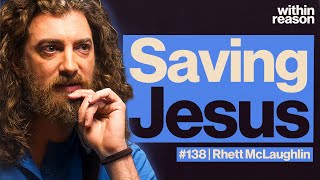
About this episodeRhett McLolin details his deconstruction from a professional evangelical Christian to a skeptic, identifying t…AI summary
Rhett McLolin details his deconstruction from a professional evangelical Christian to a skeptic, identifying the acceptance of evolution and historical biblical criticism as the primary catalysts for his loss of faith. He critiques the cognitive dissonance of Christian apologetics, noting how defenders often prioritize confirming pre-existing beliefs over engaging with contradictory evidence, a pattern he observed when comparing Christian arguments to those of Mormonism. The conversation highlights the psychological comfort of certainty versus the intellectual humility required for genuine inquiry, concluding with Rhett's current fascination with Jesus as a historical figure rather than a divine entity.
Key takeaways 5
The 'Preface Paradox' in religious certainty: Rhett illustrates how individuals can believe every individual doctrine is true while simultaneously admitting at least one must be false, highlighting the probabilistic nature of faith-based certainty.
Evolution as the first domino: Rhett's deconstruction began not with social issues but with scientific evidence (specifically retroviral DNA markers shared with chimpanzees) that contradicted his upbringing's teaching of progressive creationism, revealing that Christian apologists often provide bad-faith arguments to protect dogma.
Apologetics as confirmation bias: Rhett observes that Christian apologists often start with the conclusion (the Bible is true) and work backward to find explanations, whereas critical scholars start with evidence and work toward conclusions; this pattern of 'allegiance to the truth they need to be true' undermined his trust in the entire system.
The role of environment in deconstruction: Moving from North Carolina (Bible Belt) to Los Angeles provided Rhett with the social permission and lack of community pressure necessary to explore doubts without immediate familial or communal confrontation.
Contextualizing scripture: Rhett finds value in reading the Bible through a historical-critical lens, viewing it as ancient human literature reflecting specific cultural struggles rather than divine dictation, which allows him to appreciate moral teachings without accepting supernatural claims.
Notable quotes 4AI-generated: wording and quote attribution may be wrong. Use the play link to verify.
“I think that one of the misconceptions about someone who like me was a person of faith... is that somehow the two alternatives are that life of excess and selfishness... or religious faith in Jesus. And I think it can throw people off a lot of times when I'm like, oh, I recognize the... emptiness of a place like Las Vegas... but I'm also like, you know what, maybe every once in a while I want to go experience some excess pleasures. And not judge myself or judge others for it at the same time.”
▶ 12:58Rhett explains why his deconstruction was not a slide into hedonism but a recognition that moral clarity and fulfillment can exist outside of religious frameworks.
“There's a type of answer that someone gives when their allegiance is to the truth that they need to be true. And there's a type of answer that people who are actually interested in the truth give. And what I kept finding is that Christian apologetics... consists of people who are like, well, the truth cannot be questioned. We've predetermined that this is true and now we've got to find a way to buttress that truth.”
▶ 52:30Rhett identifies the fundamental flaw in his previous worldview: the inability to distinguish between those seeking truth and those seeking validation of their faith.
“If you had been born in a Muslim country and you were of the Muslim faith... what would your Muslim apologetic about the resurrection be? Like do you really think these arguments are as strong or is it just you need them to be true? It's so foundational to who you are, you need this to be true.”
▶ 1:09:18Rhett uses the comparison to Mormonism and Islam to highlight how cultural context shapes religious belief and how apologetics often serve to protect identity rather than establish historical fact.
“I think it was I believe it was a member of the band AC/DC who talked about God is the blanket we throw over the mystery. And so I just think that there's this magic and this mystery that I sort of want to... call that God. But I understand that that's not a there's no dogma in that.”
▶ 1:40:06Rhett describes his current spiritual stance: embracing mystery and awe without committing to specific religious dogmas or institutional structures.
 1h 36m⏭ 2
 1h 44m⏭ 1
 1h 47m⏭ 1
 1h 40m⏭ 1
 1h 36m⏭ 3
 2h 1m⏭ 1
 2h 24m
 1h 42m
 1h 31m⏭ 1
 2h 6m⏭ 1
 2h 9m
2h 9m 21m⏭ 1
 2h 3m⏭ 3
 1h 30m⏭ 5
 54m⏭ 1
 1h 17m⏭ 2
 1h 30m⏭ 1
 2h 14m⏭ 4
 2h 29m
 1h 26m⏭ 4
 1h 51m⏭ 2
 3h 18m⏭ 1
 2h 38m⏭ 1
 41m⏭ 2
 52m⏭ 2
 5h 34m⏭ 4
 1h 17m⏭ 2
 3h 32m⏭ 2
 1h 3m⏭ 1
 1h 43m⏭ 4
 1h 0m⏭ 1
 11h 54m
 11h 54m⏭ 8
 6h 26m
 33m
33m 3h 54m⏭ 7
 3h 59m⏭ 5
 9h 11m
 46m
46m 54m⏭ 1
 7h 50m