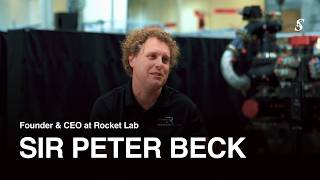
About this episodeSir Peter Beck details Rocket Lab's evolution from a humble New Zealand startup with under $100k capital to a …AI summary
Sir Peter Beck details Rocket Lab's evolution from a humble New Zealand startup with under $100k capital to a public, multi-faceted space infrastructure company. He emphasizes that extreme financial discipline and vertical integration of spacecraft components are critical for long-term survival and success in the high-stakes space industry, contrasting their lean approach with the failures of better-funded competitors.
Key takeaways 5
Rocket Lab's founding ethos was driven by extreme capital constraints; the company started with under $100,000 NZD (approx. $60,000 USD) and utilized salvaged junkyard parts, such as reconditioning ferrous fittings from scrap to save costs.
Public market listing enforces 'extreme discipline' in capital allocation, preventing the 'indigestion of funding' that causes many well-funded startups to fail spectacularly.
Rocket Lab operates as an end-to-end space company, owning the supply chain for critical components like reaction wheels and electric thrusters, creating a moat that prevents competitors from quickly scaling satellite production.
The company maintains a global footprint with 13 acres of factory space across locations including Long Beach (HQ), New Zealand, Virginia, Arizona, Canada, Germany, and Mississippi.
Mission reliability is paramount for deep space and defense contracts; missions often require 12-year lifespans in harsh radiation environments where failure is not an option, unlike short-duration LEO missions.
Notable quotes 4AI-generated: wording and quote attribution may be wrong. Use the play link to verify.
“We have no money so we have to think.”
▶ 2:54Peter Beck explains the origin of the Rutherford engine name and the company's core philosophy of innovation through constraint.
“Startups often die from indigestion of funding.”
▶ 7:14Beck argues that companies with excessive capital often fail more spectacularly than those with limited resources due to lack of discipline.
“If you turn up tomorrow and say, 'I want to build a thousand satellites.' Good luck. It's a capstone mission to the moon we did for NASA a few years ago that was done out of here.”
▶ 0:00Illustrating the difficulty of scaling spacecraft manufacturing due to a fractured and small supply chain.
“The Electron rocket was under $100 million and 80 people put the first rocket into orbit.”
▶ 0:08Highlighting the efficiency of Rocket Lab's operations compared to competitors like Virgin Orbit, which spent $1.2 billion before failing.
Chapters & Sections (12)▼
0:00Rocket Lab Founding History and Early Challengeschapter2
1:41Rocket Lab Founding and Early Development
3:08Early Funding and Launch Site Development
5:35Rocket Lab Culture and Public Market Disciplinechapter2
8:27Reasons for Rocket Lab Going Public
10:06Rocket Lab Acquisition Strategy and Integration
13:10Mission Control and Venus Life Searchchapter1
15:11Capstone Mission and Venus Life Search
18:08Spacecraft Production, Testing, and Industry Challengeschapter3
 40m⏭ 1
 49m⏭ 4
 45m⏭ 4
 56m⏭ 3
 35m⏭ 3
 59m⏭ 2
 27m⏭ 2
 46m⏭ 2
 38m⏭ 2
 32m⏭ 3
 1h 31m
 1h 49m⏭ 1
 3h 18m⏭ 1
 1h 32m
 1h 4m
1h 4m 2h 3m⏭ 2
 3h 9m⏭ 3
 1h 7m
1h 7m 2h 58m⏭ 2
 2h 45m⏭ 1
 1h 10m
 1h 25m
 1h 43m⏭ 4
 11h 54m
 1h 0m⏭ 1
 11h 54m⏭ 8
 6h 26m
 3h 59m⏭ 5
 33m
33m 3h 54m⏭ 7
 9h 11m
 5h 27m
 3h 15m⏭ 1
 7h 50m