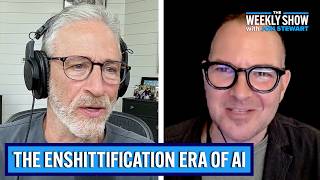
About this episodeMIT economists Daron Acemoglu and David Autor argue that AI's trajectory is not predetermined but shaped by po…AI summary
MIT economists Daron Acemoglu and David Autor argue that AI's trajectory is not predetermined but shaped by policy and corporate choices, contrasting 'pro-worker' AI that augments human expertise with current industry trends focused on mass automation and surveillance. They propose specific policy interventions including wage insurance, tax reform to favor labor over capital, and universal basic capital to ensure broad ownership and mitigate the severe economic disruptions predicted by rapid white-collar job displacement.
Key takeaways 5
AI is fundamentally different from previous technological shifts because it can automate cognitive tasks rapidly, unlike the slow transition of physical automation seen in the Industrial Revolution or China trade shocks.
The current industry agenda is driven by an ideology of AGI (Artificial General Intelligence) and centralization, which prioritizes replacing human labor over augmenting it, leading to a 'data enclosure' where companies extract value from public knowledge without compensation.
Wage insurance is a 'no-regrets' policy that has proven effective in past transitions (like the 2008-2016 era), paying the difference between a worker's old and new wage for up to two years to incentivize rapid re-employment.
Universal Basic Capital (UBC) is proposed as a mechanism to diversify income sources beyond human labor, giving every citizen an endowment of capital shares with voting rights to counterbalance the concentration of power in tech firms.
The 'meritocracy ideology' is identified as a pernicious social force that fuels political anger (e.g., the rise of Trump) by framing economic losers as morally deficient rather than victims of systemic technological and globalization shifts.
Notable quotes 5AI-generated: wording and quote attribution may be wrong. Use the play link to verify.
“Labor demand is derived demand... if they could make it without the people, they would be just as happy.”
▶ 11:58David Autor explaining why firms view human labor as a cost to be minimized rather than a value to be enhanced.
“It will allow you the benefit of productivity without the tax of human labor.”
▶ 11:02A quote from an AI executive to investors, highlighting the industry's explicit goal of removing workers from the productivity equation.
“AI is a human expertise laundering machine... This is the Napster era of AI.”
▶ 44:30Daron Acemoglu describing how AI companies extract value from human-created data and content without providing royalties or compensation to creators.
“Wage insurance says, 'Hey, look, we get that. We're going to make a path of difference for up to like say 8,000 bucks up to two years. Just take the $20, take the $15 an hour job...'”
▶ 48:37David Autor detailing how wage insurance works to help displaced workers transition to lower-paying jobs without severe financial penalty.
“You cannot understand the rise of Trump, the rise of anger in this country without that former meritocracy ideology.”
▶ 0:25Daron Acemoglu linking the political backlash against globalization and tech change to the false belief that success is solely due to virtue and failure due to lack thereof.
Chapters & Sections (34)▼
0:00The Rise of AI and Its Societal Impactschapter3
2:25AI's Impact on the Future of Work
4:11The Impact of AI on Future Workforce
5:51The Impact of Technological Transitions on Work
10:01AI and Job Displacement Concernschapter2
11:49The Limitations of Automation in the Workplace
13:25Automation and Job Displacement in the Future
15:39The Impact of AI on Human Expertisechapter1
18:30Rise of AI and Automation in Workforce
20:45Preparing for AI-Driven Job Displacementchapter1
23:20Benefits and Drawbacks of Globalization and AI
26:01The Impact of AI on Productivity and Workchapter1
27:44Rethinking the Concept of 'Proworker' in AI Era
31:05Risks of Uncontrolled AI Developmentchapter2
33:15AI's Impact on the Future of Work
34:33The Dark Side of AI and Centralization
38:15Risks of Centralized Power with AIchapter2
40:19Risks of AI and Mass Surveillance
41:47The Monetization of the Internet by AI
43:58AI and Intellectual Property Rightschapter3
46:08The Dangers of AGI in the Modern Era
47:44Wage Insurance Policy for Job Transition
49:38The Importance of AI Conversation in Society
51:12Taxation and Automation in the Workplacechapter2
53:10Corporate Influence on Technology and Politics
54:25Diversifying Economic Security through Universal Capital
57:13Concerns about Universal Basic Incomechapter2
58:44Critique of Capitalist Economic Systems
1:00:17Meritocracy and the American Dream
1:02:45AI and the Future of Work in the USchapter4
1:04:54Preparing for the Future of Work
1:06:30Corporate Power and Economic Inequality
1:07:49Regulating AI for Economic and Social Balance
 1h 37m⏭ 3
 1h 22m⏭ 3
 1h 28m⏭ 4
 1h 38m⏭ 4
 1h 33m⏭ 5
 1h 35m⏭ 3
 1h 36m⏭ 2
 1h 38m⏭ 2
 1h 28m⏭ 5
 1h 18m
 1h 52m⏭ 2
 50m
50m 1h 59m
 1h 8m
1h 8m ⏭ 2
⏭ 2 2h 29m⏭ 2
 21m⏭ 1
 3h 3m⏭ 3
 24m⏭ 1
 1h 2m
1h 2m 2h 48m⏭ 4
 1h 0m⏭ 1
 33m
33m 3h 59m⏭ 5
 54m⏭ 1
 3h 54m⏭ 7
 46m
46m 54m⏭ 2
 9h 11m
 1h 26m
 1h 13m
 6h 26m
 1h 16m⏭ 2