About this episodeFrank Burbrink, Curator of Herpetology at the American Museum of Natural History, clarifies common misconcepti…AI summary
Frank Burbrink, Curator of Herpetology at the American Museum of Natural History, clarifies common misconceptions about snake biology, behavior, and safety. The discussion covers the mechanics of snake senses (tongues, infrared vision), debunking movie myths, explaining reproductive biology, and addressing practical concerns like toilet encounters and invasive species management in the Everglades.
Key takeaways 10
Snake tongues are bifurcated to provide comparative chemical information; stronger scents on one side indicate direction for prey, mates, or predators.
The Inland Taipan is the most venomous snake by LD50 metrics (venom weight vs prey weight), but saw-scaled vipers, Russell's vipers, and Indian cobras cause the most human fatalities due to their proximity to agricultural areas in India.
Snakes have highly kinetic skulls with independent moving pieces, allowing them to 'walk' prey down their throats using re-curved teeth.
The rhyme 'red touches black, venom lack' is unreliable outside specific regions; in Central/South America, bicolored venomous snakes exist, making the rule dangerous.
Only pythonids, boas, and pit vipers possess infrared sensing capabilities via labial pits or facial pits to detect warm-blooded prey.
Snakes use multiple movement methods: undulatory (slithering), concertina (accordion-like), sidewinding (on sand), and rectilinear (belly muscles in boas/pythons).
Kingsnakes are immune to rattlesnake venom and serve as natural biological control for venomous snakes in agricultural settings.
Antivenom is produced by milking venom into farm animals (like sheep) to generate antibodies, which are then harvested for human use; it is only effective post-bite.
Burmese pythons in the Florida Everglades are an invasive species numbering in the hundreds of thousands, impacting local mammal fauna.
Snakes shed skin due to keratinized skin not growing with them; during shedding, they become cloudy-eyed and less active.
Notable quotes 5AI-generated: wording and quote attribution may be wrong. Use the play link to verify.
“If you bite it and you get sick, that's poisonous. If it bites you and you get sick, that's venomous.”
▶ 13:47Clarifying the fundamental difference between poisonous and venomous animals.
“Snakes want to do three things. They want to be left alone. They want to breed and they want to eat.”
▶ 9:40Explaining snake behavior and why movies like 'Snakes on a Plane' are unrealistic.
“The cloaca is Latin for sewer, appropriately named.”
▶ 3:42Describing the single opening used for reproduction, excretion, and urination.
“You can't take [antivenom] as a prophylactic. You can only have it after you're bitten by a venomous snake.”
▶ 23:12Explaining the limitations and production process of antivenom.
“It's actually kind of frightening when you step on those [non-rattlesnakes that mimic rattling] and you hear that noise and you're like, oh, no, it's not even a rattlesnake.”
▶ 3:14Discussing mimicry in non-venomous snakes that blow air through their epiglottis to sound like rattlesnakes.
Chapters & Sections (14)▼
0:00Snake Biology: Tongues, Venom, and Reproductionchapter2
1:49Rattlesnake Rattle Mechanics and Defense
3:22Snake Reproduction and Sex Identification
5:07Snake Anatomy, Myths, and Movie Accuracychapter2
7:16Snake Species, Evolution, and Anatomy
8:44Snake Limb Evolution and Movie Accuracy
10:22Snake Biology: Movement, Vision, and Venomchapter2
11:56Snake Vision and Locomotion Mechanics
13:22Snake Speed and Venom vs Poison
14:54Snake Toilets, Field Stories, Cobra Hoods, and Sheddingchapter1
17:06Cobra Hoods, Snake Charmers, and Shedding
19:36Snake Venom, Digestion, and Invasive Specieschapter2
 14m
14m 13m
13m 15m
15m 20m
20m 27m
27m 18m
18m 33m
33m 25m
25m 26m
26m 20m
20m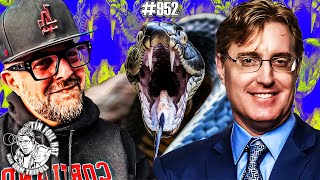 2h 17m⏭ 4
 1h 3m⏭ 1
 2h 35m⏭ 2
 1h 26m⏭ 5
 1h 23m
 1h 10m
 2h 15m⏭ 2
 55m
55m 1h 47m⏭ 1
 3h 13m
 1h 17m⏭ 1
 1h 41m
 11h 23m⏭ 1
 33m
33m 3h 54m⏭ 7
 46m
46m 1h 0m⏭ 1
 48m⏭ 2
 1h 16m
 3h 59m⏭ 5
 1h 13m
 25m
25m 54m⏭ 1
 25m
25m