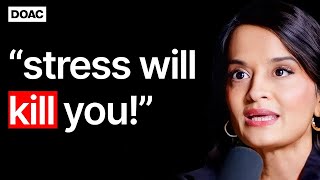
About this episodeThe guest argues that stress is a choice driven by our reaction to events rather than the events themselves, u…AI summary
The guest argues that stress is a choice driven by our reaction to events rather than the events themselves, utilizing a physics analogy where stress equals challenge divided by ability. He introduces the '90-second rule' stating that physiological stress responses flush out in 90 seconds, and prolonged stress is a result of mental rumination and negative scripting. The core solution involves prioritizing calm over ego, utilizing the 'Three L's' (Limit, Learn, Listen) to manage stressors, and engaging in daily micro-habits like gratitude and physical rest to rebuild mental and physical resilience.
Key takeaways 8
Stress Formula: In physics, stress is force divided by the square of the cross-sectional area. Similarly, human stress is challenges divided by our abilities, skills, and resources. Increasing your capacity reduces stress.
The 90-Second Rule: The biological stress response (cortisol rush) lasts only 90 seconds. If you remain stressed longer, it is because you are re-triggering the response through thoughts and stories, not because of an ongoing physical threat.
Three Conditions for Breaking: Humans break under stress via trauma (intense short-term), burnout (repetitive low-level stress/fatigue), or anticipation of threats (fear/anxiety). 93% of people exposed to PTSD-level trauma recover within 3 months, proving burnout and anticipation are the real epidemics.
Synthetic Stress: High achievers often create 'synthetic stress' believing they need pressure to perform. The guest argues that calm, focused states yield higher productivity and creativity than stressed, cog-in-a-machine states.
The 80/20 Productivity Trap: People often waste energy on the last 10% of effort for marginal gains. Prioritizing being unstressed allows for better focus on the vital 20% that yields 80% of results.
Emotions as Data: Emotions are 'batch processing' of massive data including body language and intuition. Fear alerts to danger, envy points to unmet desires, and boredom signals underwhelm. They are not bad but require interpretation.
Loneliness as Stress: Loneliness is a top cause of modern stress because humans evolved for tribal safety. Isolation triggers survival mechanisms, making face-to-face connection a critical antidote.
Physical Stress Signals: The body speaks through aches and pains. Chronic inflammation from poor diet and lack of rest is a direct signal of physical stress that must be addressed through anti-inflammatory diets and sleep rituals.
Notable quotes 5AI-generated: wording and quote attribution may be wrong. Use the play link to verify.
“An object is stressed as the force divided by the square... of the cross-section of the object similarly in humans we are stressed because of the challenges that we Face divided by our abilities and skills and resources”
▶ 0:45Explaining the physics analogy for why increasing personal capacity reduces stress.
“The infamous cortisol... will be completely flushed out of your system within 90 seconds... if you are stressed for longer than 90 seconds that is only because you yourself are perpetuating it”
Defining the biological limit of the stress response and attributing prolonged stress to mental rumination.
“You wake up every morning and you have a limited number of heartbeats... you can use those heartbeats to collect coins that you keep so that you can enjoy future Heartbeats... or you can use those heartbeats to collect enough coins and then enjoy the rest of the heartbeats”
▶ 20:40Challenging the 'deferred life' plan where people sacrifice health for future success that never arrives.
“Most of life is good... most of life is okay... if you have the brain bandwidth and Cycles to be able to contemplate something in the future or you know reflect on something in the past then that by definition means now is okay”
▶ 37:33A logical proof that our baseline state should be calm, as true danger prevents future/past contemplation.
“Committed acceptance is not to accept life as it is and then die... but to accept life as it is and commit to make life a tiny bit better just that so that tomorrow is a tiny bit better than today”
▶ 1:23:35Defining his core philosophy for sustainable improvement without overwhelming change.
Chapters & Sections (61)▼
0:00Stress is a Choice, Not a Necessitychapter4
0:00Stress in the Modern World is Unnecessary
2:24Challenging the Myth of Stress for Productivity
3:56Managing Stress for Optimal Human Performance
5:11Stress Response and Trauma in Modern Life
6:44Breaking Down Stress and Survival Mechanismschapter4
6:44Breaking Down Stress Response Mechanisms
8:06Causes of Burnout and Stress Epidemic
9:40Overcoming Shame and Emotional Resilience
11:14Managing Stress through Mindset and Choice
13:46Stress is a Choice and a Hindrancechapter3
13:46Stress and Motivation in Achieving Success
15:08Managing Stress and Motivation for Productivity
16:47Prioritizing Tasks for Maximum Efficiency
18:44Productivity and Stress in the Modern Workplacechapter2
18:44Productivity and Stress in the Modern Workplace
21:44Understanding Stress and Its Biological Response
22:56Stress Response and Human Habitatchapter2
22:56Stress Triggers in Modern vs Natural Environments
26:03Reducing Stress through Simple Life Changes
27:22Managing Stress and Finding Balance in Lifechapter2
27:22Managing Stress for Better Health Outcomes
29:44Managing Time and Priorities Effectively
31:54Managing Stress in the Modern Worldchapter1
31:54Managing Stress in the Modern World
36:34Finding the Good in Everyday Lifechapter2
36:34Gratitude Practice for Positive Mindset
38:30Overcoming Negative Thoughts with Positive Reframing
41:01Navigating Life's Challenges with Resiliencechapter3
41:01Resilience and Adapting to Life's Challenges
42:35Finding Balance in Life's Uncertain Directions
43:54Productivity and Time Zone Travel Management
46:22Struggling with Emotional Stress and Unpredictabilitychapter2
46:22Struggling with Emotional Stress and Unpredictability
49:01Emotional Response and Fear Algorithm
50:35Understanding and Managing Complex Emotionschapter2
50:35Understanding and Managing Complex Emotions
53:03Embracing Emotions for Personal Growth
54:48Emotional Awareness and Acceptance Techniqueschapter2
54:48Emotional Awareness and Acceptance Techniques
56:58Overcoming Loneliness and Emotional Stress
59:27Importance of Human Connection for Happinesschapter3
59:27Importance of Social Connection for Happiness
1:01:13Overcoming Loneliness as an Introvert
1:02:40Overcoming Loneliness through Human Connection
1:05:08Physical Stress and Its Impact on Healthchapter2
1:05:08Physical Stress and Its Impact on Health
1:07:34Managing Inflammation Through Lifestyle Changes
1:09:18Managing Physical Stress and Inflammationchapter2
1:09:18Recognizing Physical Stress Symptoms
1:11:26Importance of Rest and Healthy Eating
1:13:43Understanding Spiritual Stress and Purposechapter2
1:13:43Understanding Spiritual Stress and Purpose
1:16:13Balancing Purpose and Productivity
1:18:12Importance of Staying Focused on Life Goalschapter3
1:18:12Overcoming Procrastination and Finding Happiness
1:19:54Spiritual Beliefs and Personal Loss
1:21:42Importance of Listening to Intuition
1:23:29Importance of Consistency in Personal Growthchapter2
 2h 15m⏭ 7
 2h 38m
 1h 12m
 1h 8m⏭ 2
 1h 37m
 2h 32m
 1h 5m
1h 5m 1h 23m
 1h 53m⏭ 5
 58m⏭ 2
 1h 53m⏭ 4
 1h 28m
 2h 53m⏭ 2
 2h 34m⏭ 3
 1h 56m⏭ 3
 1h 53m⏭ 2
 1h 50m⏭ 4
 1h 57m⏭ 3
 1h 50m
 59m
59m 56m
56m 1h 20m⏭ 1
 3h 16m⏭ 3
 1h 13m
 2h 20m⏭ 4
 5h 19m⏭ 1
 1h 0m⏭ 1
 33m
33m 3h 54m⏭ 7
 54m⏭ 1
 3h 59m⏭ 5
 54m⏭ 2
 46m
46m 6h 26m
 1h 16m⏭ 2
 9h 11m
 1h 13m
 1h 26m