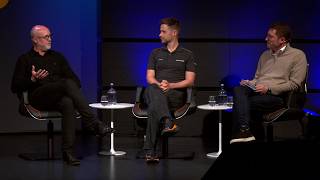
About this episodeIT leaders discuss the transformative impact of AI and Meraki infrastructure on workplace security, operationa…AI summary
IT leaders discuss the transformative impact of AI and Meraki infrastructure on workplace security, operational efficiency, and user experience. Key themes include the shift from manual network management to AI-augmented operations, the critical role of real-time sensor data in protecting physical assets, and the necessity of zero-trust security models for hybrid workforces. The conversation highlights how cloud-based visibility tools like ThousandEyes enable rapid troubleshooting and proactive threat mitigation.
Key takeaways 5
AI is shifting IT roles from manual configuration to managing AI agents; employees are being trained in 8-hour courses to support complex systems using AI assistants, reducing the need for deep initial expertise.
Real-time sensor alerts are critical for asset protection; a specific use case involves monitoring humidity levels in cigar lounges (maintaining 70°F and 70% humidity) to prevent inventory destruction via instant text alerts.
Wireless networks in high-density environments (e.g., sports venues) require dynamic AI-powered channel planning to handle massive bandwidth spikes, with one venue sustaining 2 Gbps throughput across 320 APs.
Hybrid work security requires seamless policy enforcement across all access points (Wi-Fi, 5G, wired) to prevent user workarounds, while also managing third-party vendor security postures to prevent supply chain attacks.
Network visibility tools like ThousandEyes integrate with Webex to isolate issues quickly; one case identified unstable home ISP connections causing call drops, resolved by deploying Meraki teleworker firewalls.
Notable quotes 4AI-generated: wording and quote attribution may be wrong. Use the play link to verify.
“We got these vendors that come in... HiveWatch is a group that's actually doing this AI operator thing... we're using that to reduce the load on our small business.”
▶ 13:06Robert Nichols explains how Cincinnati Open uses AI operators to analyze camera feeds and access control events, allowing a small staff to manage large-scale security incidents.
“I take a student from the school, put them in an eight-hour training... And the next day, they can take calls, do support... There is a better way. Let's just ask the AI assistant a simple question.”
▶ 14:13Ibrahim Ramku describes how Meraki and AI assistants democratize IT support, allowing junior staff to resolve complex issues quickly without years of experience.
“If the humidity goes below 70... the cigar will get destructed... he now has his laptop... he will receive a text message... it's kind of an insurance policy.”
▶ 18:31Simon Robert shares a customer success story where Meraki sensors protect high-value inventory by providing real-time environmental monitoring.
“Security is the barrier to productivity... if you make things too hard, users are pretty crafty, and they'll find workarounds... you want to make it seamless.”
▶ 22:05Troy Martin emphasizes that effective hybrid security must be invisible to the user to prevent policy circumvention.
Chapters & Sections (18)▼
0:00Introducing IT Leaders and AI Transformationchapter2
1:53Securing Critical Infrastructure with Cisco
3:24Wireless Technology and Tennis IT Infrastructure
4:54Rapid Fire: Movies Predicting Real Techchapter1
8:19Movies Predicting AI and Cybersecurity Reality
10:05AI Trust, Human Roles, and Meraki Efficiencychapter2
11:50AI Agents and Access Control Integration
13:26AI Accelerating IT Training and Network Optimization
16:35Real-time sensor alerts for humiditychapter1
18:17Cigar Humidity Monitoring with Meraki
20:30Sensors and Hybrid Work Securitychapter2
21:58Seamless Security and Device Flexibility
23:23Securing Agentic AI and Hybrid Work
25:39Securing Hybrid Work and Vendor Accesschapter1


 2h 48m⏭ 3
 43m⏭ 1
 6h 2m
6h 2m 2h 7m
2h 7m 5h 59m⏭ 8
 1h 17m
 2h 34m⏭ 4
 2h 11m
 1h 32m
 2h 28m⏭ 2
 2h 40m
 2h 16m⏭ 3
 11h 23m⏭ 1
 1h 0m⏭ 1
 33m
33m 46m
46m 3h 54m⏭ 7
 3h 59m⏭ 5
 48m⏭ 2
 40m
40m 56m
56m 1h 13m
 38m
38m 54m⏭ 2