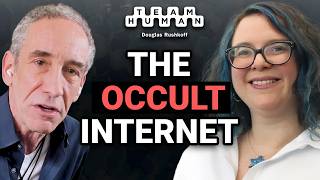
About this episodeAdam McKay and Douglas Rushkoff explore how human social structures are constrained by Dunbar's Number (approx…AI summary
Adam McKay and Douglas Rushkoff explore how human social structures are constrained by Dunbar's Number (approx. 120-150 people), a limit shaped by the Pleistocene epoch's climate instability. They argue that the end of the Holocene era and the rise of unregulated capitalism have triggered primal, tribal instincts (fear of the 'other'), which are exploited by marketing and political elites. The conversation concludes that resisting this requires reconnecting with local communities and embracing joy, humor, and direct human connection over digital isolation.
Key takeaways 7
Dunbar's Number Theory: Humans can only maintain stable social relationships with about 120-150 people. This limit evolved during the Pleistocene epoch (last 2.5 million years) due to unpredictable climate and resource scarcity, creating a 'situational morality' where groups were defensive against outsiders.
The Holocene Shift: Organized agriculture and civilization only emerged ~11,000-12,000 years ago when the climate stabilized into predictable four seasons. This allowed humans to exceed Dunbar's number through shared agricultural cycles and early religious structures that promoted cooperation ('turn the other cheek').
Post-Holocene Anxiety: We are currently exiting the Holocene era, with global temperatures rising (potentially hitting 2°C or higher). This environmental instability is triggering subconscious, Pleistocene-era survival instincts in the population, manifesting as xenophobia, anti-immigration sentiment, and tribalism.
Marketing as Primal Manipulation: Modern advertising and marketing psychology (pioneered by Edward Bernays) exploit these deep-seated, pre-Holocene fears. By framing issues through tribal lenses (e.g., anti-immigration rhetoric in countries with low immigration like Poland), elites can manipulate masses who feel overwhelmed by information overload.
The Failure of Traditional Resistance: Unions and traditional socialist structures often reify corporate power rather than dismantling it. True socialism is redefined not as a political 'ism' but as a social practice of mutual aid, community building, and 'pallet of care' (doula energy) to help society metabolize the current crisis.
Media's Role in Disconnection: The shift from broadcast television (which created a shared global 'Holocene' moment) to fragmented streaming and social media has fractured collective reality. This digital overload triggers the brain's 'Dunbar limit,' causing people to retreat into defensive tribalism or consume media that abstracts away real-world consequences (e.g., 'Friends' vs. 'The Honeymooners').
Geoengineering Requires Scale: Addressing climate change now requires massive, coordinated global effort (geoengineering, carbon removal) that small-scale 'Dunbar-sized' communities cannot achieve. This necessitates functioning large-scale societal structures, which are currently undermined by oligarchic control.
Notable quotes 5AI-generated: wording and quote attribution may be wrong. Use the play link to verify.
“The opposite of socialism is Margaret Thatcher saying there is no society.”
▶ 30:43McKay redefines socialism as the act of being social and connected to one's neighbors, contrasting it with the neoliberal ideology that dissolves community bonds.
“At least we tried. Wow, we really did have everything, didn't we?”
▶ 1:18:58McKay discusses the final scene of 'Don't Look Up,' where characters hold hands as the comet hits Earth. He identifies this moment of human connection in the face of doom as the core 'Team Human' value.
“We are empirically without a doubt outside of the Holocene. We are roughly at 1.5 degrees Celsius warmer than pre-industrial... at 2.3 C organized agriculture collapses.”
▶ 19:21Rushkoff explains that we have exited the stable climate period that allowed civilization to develop, triggering ancient survival instincts in a modern context.
“All of marketing and advertising is predicated on speaking to our pre-Holocene brain.”
▶ 31:53McKay argues that consumerism and political polarization work because they bypass logic and tap into primal, reptilian fears of scarcity and tribal threat.
“The only path we have is we have to look like we're having more fun than they are... We are the ones who are having a good time and the freaking fascist anti-immigration sloths are the ones who are having the bad time.”
▶ 34:13McKay suggests that joy, humor, and community are the most effective weapons against authoritarianism and fear-mongering.
Chapters & Sections (34)▼
0:00Political Invasion and Dunbar's Number Theorychapter2
3:26Dark Money and Planetary Crisis
5:22Dunbar's Number and Human Evolution
7:58Human Evolution and Climate Instabilitychapter1
10:46Human Evolution and Climate Impact
13:20Four Seasons, Dunbar's Number, and Religionchapter1
16:33Axial Age and Civilization's Moral Evolution
18:41Holocene End and Civilization's Social Evolutionchapter3
20:19Human Evolution and Elite Control
22:04Elite Influence and Middle Class History
23:40Pyramidal Civilizations and Social Isolation
27:15Socialism, Unions, and Marketing Psychologychapter1
29:35Socialism, Unions, and Marketing Psychology
33:15Dunbar's Number, Tribalism, and Post-Holocene Mediachapter3
35:32Bill Clinton's Reaganite Policy Agenda
36:58Dunbar's Number and Tribal Instincts
39:49Television Peak and Post-Holocene Wall Politics
41:41Media Fragmentation and Biblical End Timeschapter1
44:04Media Fragmentation and Biblical End Times
48:01Climate Crisis Transition and Geoengineeringchapter1
50:46Geoengineering and Carbon Removal Hail Mary
53:52Climate Resilience and Nuclear Reactor Riskschapter1
57:34Slowing Down and Reducing Consumption
59:12Improv History and Social Media Critiquechapter2
1:01:32Improv Theater Privatization Impact
1:03:11Social Media Hacking and Human Nervous System
1:07:20Media's Escape from Reality and Consumer Controlchapter3
1:09:11Friends TV Show Disconnect From Reality
1:11:02Evolution of TV Realism and Network Rejection
1:13:05Media Abstraction from Reality
1:16:24The Angel and the Devil on the Shoulder: Adam McKay on Surviving the Post-Holocenechapter3
1:19:06Collaborative Script Refinement on Set
1:20:56Filming The Angel and the Devil on the Shoulder
 1h 5m⏭ 1
 1h 10m⏭ 1
 30m⏭ 1
 1h 6m⏭ 2
 1h 14m⏭ 1
 1h 26m⏭ 3
 1h 22m⏭ 3
 21m⏭ 3
 57m⏭ 3


 2h 37m⏭ 2
 2h 57m
 1h 24m
 3h 6m⏭ 1
 3h 23m⏭ 5
 1h 46m
 1h 6m
1h 6m 2h 4m⏭ 2
 1h 41m⏭ 4
 45m
45m 1h 32m
 3h 36m⏭ 1
 1h 0m⏭ 1
 33m
33m 46m
46m 3h 54m⏭ 7
 3h 59m⏭ 5
 54m⏭ 1
 1h 13m
 54m⏭ 2
 58m⏭ 5
 1h 16m⏭ 2
 45m⏭ 2
 1h 26m