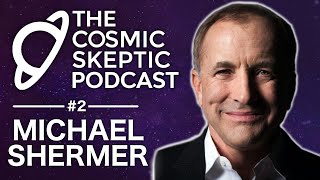
About this episodeMichael Shermer and Neil deGrasse Tyson discuss the nature of objective truth, contrasting scientific empirici…AI summary
Michael Shermer and Neil deGrasse Tyson discuss the nature of objective truth, contrasting scientific empiricism with motivated reasoning and postmodern skepticism. They explore cognitive biases like patternicity and my-side bias, arguing that while humans are prone to self-deception, the scientific method's reliance on peer review and probabilistic thinking offers the best path to provisional truth.
Key takeaways 5
Objective truth is defined as something confirmed to such an extent it is reasonable to offer provisional assent, acknowledging fallibilism (the possibility of being wrong).
Science differs from other narratives because it actively seeks disconfirmation through peer review and external validation, whereas human brains are evolutionarily wired for motivated reasoning (winning arguments) rather than finding truth.
Cognitive biases such as 'patternicity' (finding meaning in random noise) and 'my-side bias' (believing things because they align with tribal identity) lead people to accept false narratives like conspiracy theories.
Religious texts should be interpreted as literature providing moral lessons rather than empirical historical claims, avoiding the error of treating fiction as fact or vice versa.
AI tools like LLMs suffer from 'confabulation' (hallucinations), requiring users to verify sources critically, similar to how humans fill memory gaps.
Notable quotes 5AI-generated: wording and quote attribution may be wrong. Use the play link to verify.
“They may sometimes get it wrong, but your dumb ass always gets it wrong.”
▶ 0:28Shermer emphasizes the importance of trusting expert consensus and institutions over individual internet research.
“Our brains are more like lawyers than scientists. We want to win the case for our side, not find out what's actually true.”
▶ 13:46Explaining the evolutionary basis for motivated reasoning and confirmation bias.
“The plural of anecdote is not data.”
▶ 41:58Shermer's response when someone cites personal experience (like an aunt recovering from a disease) as evidence for a medical claim.
“A servant of belonging.”
▶ 20:20Shermer's phrase describing how people adopt beliefs (like conspiracy theories) primarily to signal loyalty to their social group rather than based on evidence.
“If you think that the rustle in the grass is a dangerous predator, and it turns out it's just the wind, that's just a false positive, no big deal... But if you make the other kind of error... you get a Darwin award for taking yourself out of the gene pool early.”
▶ 30:41Explaining 'patternicity' and why humans are biased toward seeing patterns even when none exist.
Chapters & Sections (27)▼
0:00Defining Objective Truth and Fallibilismchapter6
2:14Introduction to Truth and Post-Truth World
4:05Objective Truth and Fallibilism
5:56Dragon in Garage Thought Experiment
7:35Internal Experience vs External Validation
9:15Rationalizing Altered States of Consciousness
10:30Personal Truths vs. Objective Evidence
12:32Science vs Motivated Reasoning and Biaschapter2
13:58Motivated Reasoning and Confirmation Bias
15:38Evaluating Evidence and Mass Trust Bias
16:56Trust, Bayesian Reasoning, and AI Hallucinationschapter2
19:14AI Hallucinations and Belonging Bias
21:08Bayesian Reasoning and Fluid Truth
22:31Religion as Literature vs Empirical Truthchapter1
24:24Post-Truth Era and Postmodernism
27:12Cognitive Biases and Patternicitychapter1
29:19Patternicity and False Positives
31:15Real vs Imagined Conspiracies and Scientific Consensuschapter2
33:51Truth, Consensus, and Political Reality
35:06Trust and Value of Currency
36:39Social Media Bias and Scientific Skepticismchapter2
38:50Scientists' Role in Public Communication
40:36Defining Healthy Scientific Skepticism
42:58Postmodernism, Truth, and Vaccine Skepticismchapter3
45:04Research Standards and Vaccine Hesitancy
46:36Addressing Vaccine Skepticism and Misinformation
 1h 45m⏭ 1
 1h 17m
 1h 14m⏭ 1
 1h 43m⏭ 1
 1h 0m⏭ 1
 26m
26m 56m
56m 53m
53m 1h 7m
1h 7m 1h 6m
1h 6m 55m⏭ 1
 49m
49m

 3h 57m⏭ 3
 2h 33m⏭ 2
 2h 34m⏭ 4
 2h 49m⏭ 2
 2h 57m⏭ 2
 1h 21m
 1h 28m⏭ 1
 1h 28m⏭ 2
 2h 16m⏭ 2
 1h 37m⏭ 1
 1h 51m⏭ 1
 1h 50m⏭ 1
 1h 0m⏭ 1
 33m
33m 46m
46m 3h 54m⏭ 7
 3h 59m⏭ 5
 54m⏭ 1
 1h 13m
 54m⏭ 2
 58m⏭ 5
 1h 16m⏭ 2
 45m⏭ 2
 1h 26m