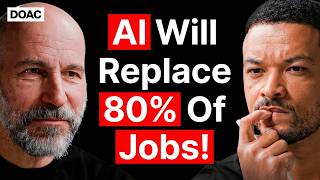
About this episodeAlex Karp argues that AI and automation will disproportionately displace white-collar workers, necessitating a…AI summary
Alex Karp argues that AI and automation will disproportionately displace white-collar workers, necessitating a societal shift toward vocational training and away from traditional university models. He emphasizes that Palantir’s value lies in integrating human tribal knowledge with AI to solve complex, real-world problems that pure software cannot handle, while advocating for strict protection of individual rights and military superiority to navigate the geopolitical and economic disruptions caused by these technologies.
Key takeaways 6
Dead hangs and specific physical metrics are accurate proxy indicators for overall health and longevity, unlike bench press which may indicate a 'short but glorious life'.
AI agents will commoditize low-end coding, reading, and writing, making neurodivergent individuals and those with deep technical expertise more valuable as they can leverage AI to build unique solutions.
Palantir’s business model relies on 'tribal knowledge' and institutional context, which cannot be easily replicated by pure software companies or AI alone.
The US must maintain military superiority in AI to counter adversaries like China, even if it means deploying technologies that are controversial domestically.
The current education system is failing neurodivergent students by forcing them into academic tracks that do not leverage their strengths, whereas vocational training in countries like Germany provides high-value skills without debt.
There is a risk of political radicalization if society does not address job displacement, potentially leading to calls to nationalize tech companies or harm the wealthy without providing viable alternatives for the displaced workforce.
Notable quotes 5AI-generated: wording and quote attribution may be wrong. Use the play link to verify.
“Dead hang is important. Dead hanging is crucial. Especially anyone watching your podcast is likely to outperform. You want to have some, you know, you want to be able to do something with that outperformance.”
▶ 1:28Karp explains why the dead hang is a critical fitness metric for high-performers.
“Odin has come down from or Locky has come down and said you know what carp you suffered so much as a kid I'm just going to make the whole world so everyone else can suffer... The thing that they can do that used to be valuable is not so valuable. The thing that they need to learn to do is like be more of an artist look at things from a different direction be able to build something unique.”
▶ 3:42Karp discusses how AI levels the playing field for dyslexic and neurodivergent individuals by devaluing rote skills while elevating creative and unique problem-solving.
“The value of the business is not a monolithic codebase that never changes it is the people it is the deployment is the relationships is that how you're thinking about the business these days.”
▶ 8:34Karp distinguishes Palantir’s value proposition from traditional software companies, emphasizing human-centric deployment and institutional knowledge.
“We're we're going to take your job. we're going to take away you're going to eviscerate your ability to to to have money and power but that we're not going to defend you on the battlefield just seems like yeah well they're gonna you know what's actually going to happen that nobody believes me in tech but there's going to be a movement in this country that gets very strong very quickly to nationalize these things.”
▶ 16:06Karp warns of the political backlash if tech companies fail to justify their role in job displacement by demonstrating national security value.
“Germany has three high schools. Yeah. Two are vocational. Sure. One is academic... Vocational training in Germany is very technical. Like the people building the cars at BMW or even in the French version Airbus like very complicated jobs. They didn't go to college. They went to a very very high-end high school and they come out without any debt.”
▶ 20:35Karp cites the German education model as a superior alternative for creating skilled workers without the burden of student debt.
Chapters & Sections (13)▼
0:00Importance of Dead Hang in Fitnesschapter3
1:20Importance of Vocational Training in the Future
3:26The Value of Human Skills in an AI World
6:37The Impact of AI on Traditional Industries
8:01The Importance of Institutional Knowledge in Businesschapter1
10:00The Role of Government in AI Decision-Making
12:29Protecting Individual Rights in a Technological Erachapter1
14:44AI in Military Context and Job Displacement
17:10Addressing Job Loss and Technological Displacementchapter2
19:09Comparing Economic Systems and Social Policies
20:52Transforming Education and Workforce Development
22:54Addressing Job Loss and Economic Inequalitychapter1
 40m
40m 1h 11m⏭ 3
 28m
28m 2h 21m⏭ 3
 31m
31m 1h 2m
1h 2m 2h 30m⏭ 1
 2h 24m⏭ 1
 30m
30m 2h 28m
 23m
23m 29m
29m

 1h 2m⏭ 3
 2h 6m⏭ 1
 1h 43m⏭ 2
 2h 52m⏭ 3
 56m
56m 3h 18m
 3h 9m⏭ 3
 2h 20m⏭ 4
 2h 2m
2h 2m 3h 3m⏭ 1
 1h 7m
1h 7m 1h 29m
 1h 43m⏭ 4
 11h 54m
 1h 0m⏭ 1
 11h 54m⏭ 8
 6h 26m
 33m
33m 3h 59m⏭ 5
 3h 54m⏭ 7
 9h 11m
 46m
46m 54m⏭ 1
 3h 15m⏭ 1