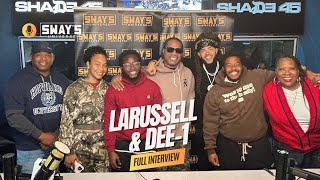
About this episodeLaRussell discusses his independent business model, emphasizing ownership of intellectual property, direct-to-…AI summary
LaRussell discusses his independent business model, emphasizing ownership of intellectual property, direct-to-fan sales via the platform Even, and equitable revenue sharing with his team. He contrasts this with predatory label deals, highlighting the importance of transparency, self-education in music business mechanics, and the collaborative spirit of the Bay Area hip-hop community.
Key takeaways 5
Ownership is critical: LaRussell stresses that artists must own their masters and publishing to build generational wealth, noting that labels often recoup costs (marketing, videos) against low artist royalties (e.g., 8%), leaving artists in debt.
Direct-to-fan monetization: Using the platform 'Even', LaRussell allows fans to set their own price for albums (pay-what-you-want), which has resulted in some fans paying up to $2,500, leveraging the perceived priceless value of the art.
Team equity over upfront cash: Instead of paying team members standard wages, LaRussell gives them equity/percentage of revenue, ensuring long-term financial security for his inner circle (family and staff).
Bay Area independence tradition: LaRussell cites E-40 (Sick Wid It Records) and HBK (Good Company) as influential models for independent hustle, direct sales, and community building, which he has modernized with blockchain technology.
Transparency builds trust: Sharing the struggles (missing shots, losing money early on) and successes openly helps maintain humility and strengthens relationships with fans and team members.
Notable quotes 5AI-generated: wording and quote attribution may be wrong. Use the play link to verify.
“I don't know what it's worth to me. It's priceless. So I'm not gonna put a number on it, but you could tell me what it's worth to you, and I'll accept that.”
▶ 23:56LaRussell explains his 'pay-what-you-want' pricing strategy on his album 'I Hate When Life's Going Great', arguing that the value of his art is infinite and letting the consumer decide the price.
“We only learn about the people who did something. We don't learn about the people who talk about doing [__] and who think about doing it. We learn about the people who do it.”
▶ 6:22LaRussell advises aspiring artists to stop making excuses and focus on execution, emphasizing that history remembers action, not intention.
“You should always have to come through me if you want to buy my music. You shouldn't have to go through Spotify.”
▶ 21:10LaRussell discusses his strategy of owning his ticketing and distribution platforms to maintain direct relationships with fans and avoid middlemen taking cuts.
“If you only get into ten percent and they ran five thousand dollars [on ads], you got to recoup fifty thousand dollars and pay back five thousand dollars worth of ads. What are we doing? That's insane.”
▶ 52:58LaRussell breaks down the predatory nature of label recoupment structures, illustrating how artists can end up owing money despite generating revenue.
“I live by this ideology of demonstration speaks louder than conversation. I don't have to say nothing. Sometimes I'm doing everything so you see. You see the motion.”
▶ 12:19LaRussell explains his leadership style, particularly in early days when he couldn't pay his team, relying on visible hard work and future equity promises rather than just words.
Chapters & Sections (40)▼
0:00Hip-Hop Entrepreneurship and Independencechapter6
0:00Hip-Hop Entrepreneurship and Independent Success
1:59Tech N9ne and Strange Music's Autonomous Era
3:20Artist's Inspirational Story of Success
4:43Russell Citizens Live Performance in Bay Area
6:05Overcoming Self-Doubt and Achieving Success
7:40Artist Discusses Frustrations with Traditional Label
10:37Importance of Appreciation and Transparency in Leadershipchapter2
10:37Importance of Appreciation and Transparency
12:24Entrepreneurial Mindset and Business Equity
14:34Artist Discusses Love and Productivitychapter2
14:34Artist Discusses Love and Productivity in Relationships
16:13Personal Experience with Psilocybin and Cannabis
18:47Influential Movement in the Bay Areachapter2
18:47Influential Movement in the Bay Area
21:16Music Business and Overcoming Fear and Insecurity
22:57Setting Priceless Value on Artistic Workchapter3
22:57Self Worth and Pricing Value
24:40Monetization and Streaming for Musicians
26:53Music Distribution and Streaming Platforms
28:32Music Industry Financial Advice and Ownershipchapter4
28:32Music Industry Financial Advice from Russell
30:39Artist Credits and Monetization in Music Industry
32:43Artist Discusses Music Ownership and Collaboration
34:22Dealing with Fame and Self-Doubt
35:37Bay Area Music Scene and Collaborationchapter2
35:37Bay Area Music Tradition and Collaboration
37:37Music Consumption and Collaboration Discussion
40:05Hip-Hop Culture and Its Core Elementschapter3
40:05Hip-Hop Culture and Its Preservation
41:31Hip-Hop Culture and Authenticity
42:58Overcoming Adversity and Self-Doubt
45:19Russell's Message to the Music Industrychapter2
45:19Russell's Message to the Bay Area
47:50Music Industry Criticism and Ownership
51:39Artist Rights and Industry Predatory Practiceschapter4
51:39Music Industry Predatory Practices Exposed
54:02Business Growth with Partner and Team
55:23Celebrity Discusses Collaboration and Community Growth
 1h 19m
 49m
49m 58m
58m 43m
43m 39m
39m 54m
54m 39m
39m 46m
46m 36m
36m 36m⏭ 1
 30m
30m 29m
29m 2h 30m⏭ 1
 1h 32m
 1h 42m
 1h 49m⏭ 2
 1h 7m
1h 7m 1h 6m
1h 6m 58m⏭ 1
 3h 6m⏭ 1
 45m
45m 1h 47m⏭ 1
 1h 35m
 1h 7m
1h 7m 1h 43m⏭ 4
 11h 54m
 1h 0m⏭ 1
 11h 54m⏭ 8
 33m
33m 6h 26m
 3h 54m⏭ 7
 9h 11m
 3h 59m⏭ 5
 46m
46m 54m⏭ 1
 54m⏭ 2